[W]hat we believe is not merely what we formulate and subscribe to, but behaviour is also belief, and even the most conscious and developed of us live also at the level on which belief and behaviour cannot be distinguished [T.S. Eliott]
You are the Japanese emperor in 1864. Your nation has been humiliated by the West and you need to modernise fast. One day your advisors come to you with an urgent question: do we use forks and knives or chopsticks when eating steak? You wrinkle your brow as you are faced with yet another imponderable matter of national importance.
The question is part of a much broader debate about how Japan should achieve bunmei kaika, or ‘civilisation and enlightenment.” One prominent culinary program was increasing Japanese beef consumption. The average Japanese man in 1865 was around 5 foot 1 inches compared to an average Westerner at 5 foot 7 inches. Many Japanese intellectuals believed this was in part due to the vast amount of beef consumed by westerners. Japanese restaurants resisted their recommendations to eat more meat, however, mocking this attempt to westernise their menus.
In response, the Kyōbushō (Ministry of Religious Instruction) issued three prescriptions in 1872 insisting on “Obedience to the Emperor and his Will should be inculcated.” Several guides on Western cooking were released following these prescriptions emphasising, in their prefaces, the importance of following the Imperial will. They explained how to eat the new western food, including guides to the new western utensils:
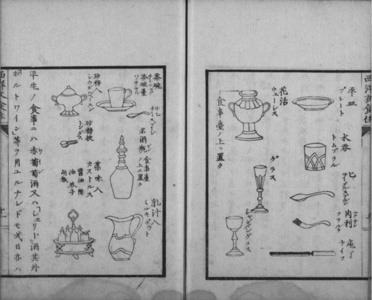
Strangely, these books insisted not only on carrying over the consumption of beef but also Western table manners. This copying was a matter of practical diplomacy: to be accepted by the Western nations as leading a civilised nation, Japanese elites had to master the Western culinary norms. But it was also due to the belief that the industrial prowess of the West followed from their entire civilizational stack rather than isolated designs. The intellectual Fukuzawa Yukichi, for example, recommended Japan entirely Westernise its culture to compete:
A watch is a somewhat irrelevant subject as regards Western living, but the author believes it is quite necessary to familiarise oneself with reading the time; all people carry a watch in the West to know the time without relying on temple bells as in our country.
As it turned out, not all Western culture was necessary to industrialise. One can build vast factories and battleships without using knives and forks. What fascinates me about these strange debates in Japan is their epistemic uncertainty: what is functionally necessary in a culture? How much of the techno-cultural stack do you need to achieve social development? At an intuitive level culture does seem linked causally to technology. In part this is an illusion of epiphenomenality: we associate norms and behaviours with mere surface cultural forms of those who created them. There is also likely some reverse causation: technological changes impose functional restraints on culture. One cannot imagine feudal clothing under sumptuary laws in the factory because it seems dangerous and inconvenient.
But these aside, there is still an intuition that some cultural forms encourage or hinder social progress. Certain cultural practices seem to create (or possibly constitute) a cultural perspective which plays a causal role in invention and social organisation. The wristwatch might appear to be a male accessory, but what if it is actually deeply linked to a way of perceiving time and organisation? Might it be related to school bells, the fines for lateness, the pub closing hours, the train schedule, and the factory whistle?
Obsessing over knives and forks was the default mindset of most people in the 19th century before being suppressed as culturally imperialistic in the 1960s. Nevertheless, this obsession is growing in popularity once again. The viral excerpt from Lee Kwan Yew’s memoirs provides a good example. LKY described a pile of newspapers in 1950s London with a can requesting two shillings in payment: this is taken to show some fundamental aspect of English life then which is, perhaps, absent now. If you visited the capitol of a foreign country and found they littered incessantly, or wore shabby clothing in their parliament, what effect would this have on your opinion of them? Would you be satisfied with the claim ‘it's not that deep?’
The Knives and Forks theory of culture is not that these specific examples are load-bearing practices. It is that it is uncertain because cultural practices are interconnected in obscure and subtle ways. In hindsight, the difference between wristwatches and spoons appears clear, but at the time it is hard to say what the deeper implications of the former or the latter were. And it raises another, very old question: what cultural practices today should we keep, and which should we throw away?