Southport, the 9th of July 2024. It is the hottest year in recorded history. A bead of sweat runs down your forehead. A few kilometres away, 18-year-old Axel Rudakubana murders three young girls at a Taylor Swift themed dance class. Elise Dot Stancombe, Bebe King, and Alice da Silva Aguiar, aged seven, six, and nine respectively. In addition to these three, Axel stabbed eight other children and two adults, with his Amazon knife. He showed no signs of remorse following this mad assault. Most worryingly of all, Axel had no specific ideology. He was merely “obsessed with violence.” His sentence is 52 years in prison. In the shadow of this atrocity something became clear: the Southport stabbings could have been prevented. Axel had already been referred to the Government’s counter-terrorism programme Prevent – three times in fact. And yet his case was never escalated. We must keep in mind tragedies like Southport when discussing Prevent – the true subject of this essay – and the strange trajectory of domestic terrorism in 21st century Britain.
Prevent is a quixotic programme, simultaneously reviled and somewhat obscure. It was initially introduced as one of the “4 P’s” of the government’s CONTEST initiative, developed in 2006 as a response to 9/11. The purpose of CONTEST is not to completely eliminate terrorism (“the optimal amount of terrorist attacks is not 0”) but to reduce it to a sufficiently low level that citizens can live their ordinary lives in peace. In 2015 Prevent was expanded to most “core agencies”, whereby schools – and other agencies – were put under the Prevent Duty. This duty requires them to refer pupils they fear are at risk of radicalisation to the agency known as ‘Channel.’ Following such a “Prevent referral”, the at-risk pupil is assessed by a Channel Panel which may recommend further support. 1 Channel cases involve mentoring, monitoring, training for parents, and theological support if relevant. What this entails is case-by-case; a memorable example given by one mentor encapsulates the odd mixture of the banal and vaguely sinister which pervades Prevent:
[Mentoring] means getting people “back to a factory setting of normal life”. Kebabs are his currency in winning trust: he meets his “clients” in chip shops and fried-chicken joints, then takes them for a dose of fresh air, pounding round parks while talking, questioning and offering another point of view. 2
There are around 3000 referrals for children every year - of which around 90% are boys - and each referral carries significant social implications. No-one wants their child labelled a potential terrorist for drawing pictures of guns in class. Here a distinction is important: whilst the Channel treatment is a purely voluntary programme (although consent can be given by parents for those under-18), the referrals are made at the discretion of agency workers. Referral and successful Channel de-radicalisation are, of course, not the same thing. The perpetrators of the London Bridge attack, Parson’s Green train bombers, and murderers of David Amess had all been referred to Prevent but did not progress more deeply into the system.
Such disasters do not indicate Prevent a failure. The terrorist attacks which slip through the Government’s “4 P’s” are a fraction of the total threat. Between March 2017 and July 2023, British Counter-Terrorism agencies prevented 39 late-stage terrorist plots . We are told regularly from both diligent Government circulars and salacious newspapers that but-for Counter-Terrorism untold mayhem would unfold across the nation From this, we are to infer a simple fact: under the surface of sane society is a darker, madder world, one roiling, growing, threatening to burst through the “thin blue line” and disrupt our ordinary lives. The modern western society is open, high-trust, and porous. The average citizen is vulnerable – a soft white belly turned to the sky – ready to be sliced and stabbed. Who or what constitutes this great threat?
Historically, the principal terrorist threat was Irish republican dissident groups like the RIRR, CIRA, and ONH. This threat has altered over time. Throughout its early phase, Prevent was straightforwardly – if problematically – defined as a tool for combating organised, ideologically coherent Islamic extremists. The 2011 Strategy made this clear: the threat is not Islam per se, but a particular brand of violent religious dogmatism. The most important weapon in the war for terror is philosophical: we need to show how Islam and liberalism are in fact compatible using persuasive ideas and detailed theological arguments. The government reports from this period exude reasonable optimism: in 2009, Prevent was said to be engaged in “the battle of ideas… challenging the ideologies that extremists believe can justify the use of violence….” The Government’s 2011 “CONTEST” Strategy continued this theme, noting: “challenge may mean simply ensuring that extremist ideas are subject to open debate”, relying in particular on sympathetic, moderate Muslims. Another report from the same year specified the terms of the government in this debate. It suggested we need to be ‘confident’ in our own values: universal human rights, equality before law, democracy, equality of opportunity, and “full participation in our society”, said to further a “cohesive, integrated, multi-faith society and of parliamentary democracy.” In this 2011-2014 period, CONTEST, however flawed, was at least a coherent project and had an underlying philosophy in the form of David Cameron’s policy of “Muscular Liberalism”. It identified the primary battlefield as one of ideas where “ideological challenge” was the first and most important frontier of Counter-terrorism. 3
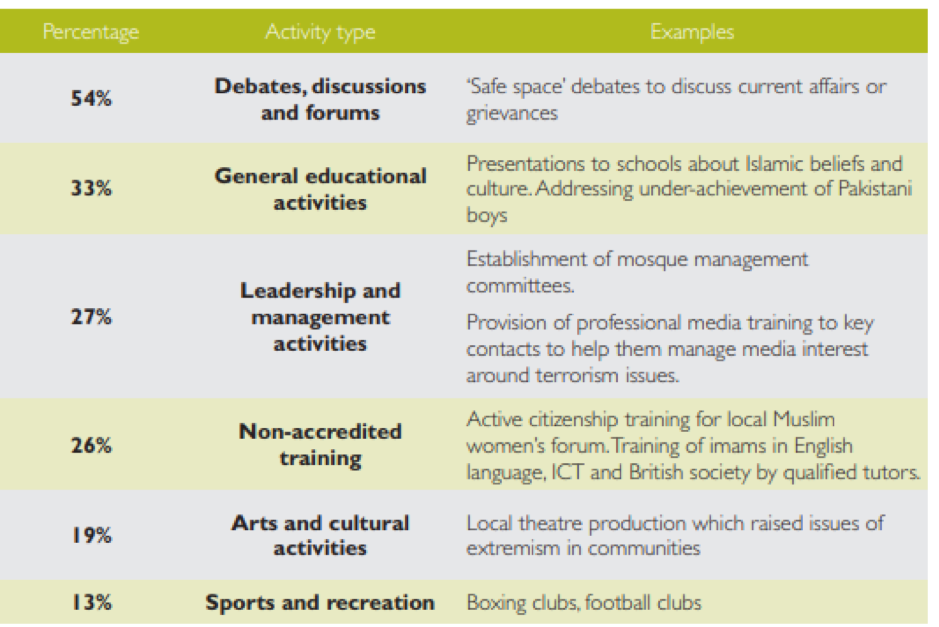
Prevent came under sustained criticism for its perceived authoritarianism, and its racial and religious biases. Countless articles 4 and reports by academics 5 and NGOs 6 were published canvassing a buckshot-spread of objections. At this stage the Counter-Terrorism debate was still comprehensible. The Government’s position from 2011-2014 was that terrorism is caused by a malicious ideology feeding on the negative emotions produced by community tensions. In theory, these community tensions can be eased through a mixture of (A) argument, persuasion, and debate (in the context of free speech); and (B) community outreach, collective healing, and mental-health support:
This is what I refer to as the modernist framing of terrorism: the terrorists are a philosophically and logistically coherent group which must be combatted through sincere arguments and social improvements locally. The critics’ response was that “Islamic fundamentalism” is a marginal phenomenon and does not represent Islam in general; that the Government’s Counter-Terrorism policy risks reproducing racist narratives, alienating moderate Muslims, and entrenching community divisions; and that the greater danger to integration is far-right reaction rather than Islamic fundamentalism. Thus, they diagnose the same dilemmas but different causes. They both lived inside the modernist view: if the structural problem of community tensions – or the Northern Irish border, or the class divide and capitalism, or our relationship with nature - can be solved, political violence will vanish like a bad dream.
Over time, however, the terrorist threat has become muddied and this framing has disintegrated. The state is no longer concerned exclusively with coordinated terrorist attacks like those of the IRA or Al Qa’ida. Instead, it deals increasingly with the lone-wolf terrorist radicalised online, referred to by the MI5 Threat Update as “The wicked problem of self-initiated lone actor terrorists, fiendishly hard to detect and disrupt.” 7 The ideologies targeted have also fragmented. According to the modern Prevent programme there are three major ideologies which motivate terrorism:
The second of these covers a vague melange of “Cultural Nationalism” 8 , “White Nationalism”, and “White Supremacism.” Warning signs are said to include “religious or ethnic superiority, antisemitism, misogyny, anti-establishment and anti-LGBT grievances.” In general, ERWT terrorism seems to cover an undifferentiated mixture of right-wing beliefs fused with violence. This category has steadily expanded in Prevent referrals. 9 In 2015 65% (4997) of all Prevent referrals were for Islamic Extremism, reflecting this period’s preoccupations. 10 From 2020 onwards, 11 however, Far Right extremists overtook Islamic Extremism as the most prevalent cause of referral and overrepresent in Channel cases. 12 In addition, by 2020, for the first time since 2018, far-right terrorists were prosecuted at a higher rate than Islamists for terrorist offences. 13 One view, taken by conservative commentators, was that this represents a kind of establishment “anti-right” bias, swinging the other direction from the prior focus on Islamic fundamentalists.
This view is outdated: the Government has moved on from the modernist world where Prevent is a tool to fight for a “correct” ideology. Prevent is not confined to the Extreme Right or any specific political programme. As left-wing commentators aptly point out, there is also the third rag-bag category of “extreme political left-wing” which covers an equally undifferentiated mixture of left-wing extremists, 14 ranging from anarchists to vegans and animal-rights activists. 15 It does not take a philosopher to see the incoherency of this Borgesian list of ideological evils. Nor are Far-Right referrals even leading the Prevent scoreboards. In the last two years a newer, stranger threat has surpassed both Far-Right extremism and Islamic fundamentalism: the “mixed-ideology” terrorist. 16 As the 2023 CONTEST report notes, the advent of the internet has rendered the ideological beliefs of terrorists increasingly incoherent and jumbled up. Children are murdering their peers for reasons so vague and blurred that the state has given up classifying them. 17 The incoherence has infected the language of the Prevent programme itself.
A survey of Prevent training material from 2015 onwards reveals philosophical decay: although framed in ideological terms, the Government has essentially lost interest in the intellectual or ideological components of extreme beliefs. 18 These are invariably vague and ill-defined in the Prevent training materials. 19 The Government’s model of extremism is now non-rational: people are radicalised because of contextual social reasons and it is these reasons – not their ideology per se – which need to be addressed. There is no more talk of free speech or the “battle of ideas.” The paradox of Prevent is that ideology is integral to the programme, for it defines the boundary between terrorism and ordinary crime, but now virtually absent in practice. Much of the current criticism of Prevent is therefore entirely beside the point. 20 Criticisms like: what if the Government designates “transgenderism” as an extremist ideology? Is the Government focusing too much on white nationalists instead of Islamists? What if Prevent becomes a tool for Neo-conservatism? Or maybe the increased Far-Right referrals are actually a form of white privilege? Here’s the thing: none of that matters. The war being fought is not against the enemies of the Tsar, King, or emperor, nor the Catholic Church, Communist revolution, minorities, Big brother, the white patriarchy, our Christian nation, or even Britain: it is against the enemies of liberal peace. In the simple, honest words of the anti-piracy advert: the terrorists threaten “Our way of life and your future enjoyment.” The logic of Prevent is not the religious language of heretics, but the sanitised, medico-professional jargon of ‘risk.’ 21 Islamic fanatics are targeted because they are perceived to pose a threat and induce fear; under the same logic we persecute right-wing nutjobs, vegans, anarchists, Palestine protestors, and those who support any “single-issue” violently.
The logic of “risk” is gentler and more suffocating than full-bodied ideological opposition. Ideological opponents are imprisoned but they at least have the opportunity to repent, convert, change their minds, or die waiting for a regime change. Room 101, however horrific, at least has the decency to treat your views and beliefs as if they matter. In the turgid, jargon-filled world of 2020s Prevent those who pose a “danger” are imprisoned so long as they remain dangerous regardless of their guilt, repentance, or the governing party. There is no escape from risk. A good example of this is the recent IPP scandal. From 2005 to 2024 the UK government imprisoned people using a special kind of sentence known as the “Indefinite Sentences for Public Protection (IPP).” Provided the prisoner remained “dangerous” – a state analogous, in prison logic, to being “sane”- they would remain incarcerated. Some people served several life sentences under their IPPs. Had they merely been blamed and imprisoned as to express this social condemnation they would have been freed years ago. But risk-assessment does not concern itself with blame. Philosopher of Free Will G.A. Strawson called this the “objective attitude” towards human beings:
To adopt the objective attitude to another human being is to see him, perhaps, as an object of social policy; as a subject for what… might be called treatment; as something certainly to be taken account, perhaps precautionary account, of; to be managed or handled or cured or trained; perhaps simply to be avoided, though this gerundive is not peculiar to cases of objectivity of attitude. The objective attitude may be emotionally toned in many ways, but not in all ways: it may include repulsion or fear, it may include pity or even love, though not all kinds of love. But it cannot include the range of reactive feelings and attitudes which belong to involvement or participation with others in inter-personal human relationships; it cannot include resentment, gratitude, forgiveness, anger, or the sort of love which two adults can sometimes be said to feel reciprocally, for each other.
If your attitude towards someone is wholly objective, then though you may fight him, you cannot quarrel with him, and though you may talk to him, even negotiate with him, you cannot reason with him. You can at most pretend to quarrel, or to reason, with him.” – P.F. Strawson Freedom and Resentment.
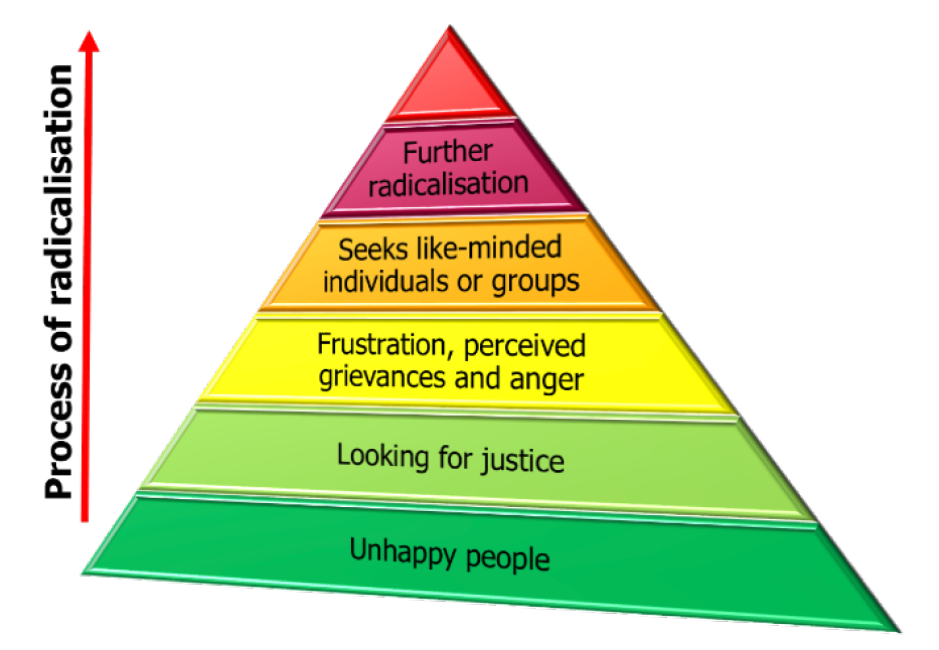
The modern Prevent programme does not see people as agents who need to be reasoned with. It sees them as centres of risk which must be managed or assuaged. According to Prevent, all terrorists are stochastic terrorists. You and I are on a continuum with the mad bomber where one end is “unhappy people” and the other is “unspeakable monster.” The only difference is that the terrorist’s risk coefficient is sufficiently high that we demand the Government do something about it. What increases someone’s risk coefficient? Of those referred to Prevent today, it is estimated around 13% were autistic (against a 1% base rate); of those convicted of a terrorist offence, 31% of minors had a formal diagnosis of neurodiversity or mental health conditions. The last citizenship survey from 2010 traced other concerning demographic trends: extremism was popular, in particular, with younger people, those from lower income groups, the “poorly educated” (with a few cases of “high-achieving individuals”), the unemployed, those who believe ethnic groups shouldn’t mix, and, worst of all, “those who distrust Parliament.”
22
Current Prevent training materials elide triggers for radicalisation with triggers for “safeguarding” concerns.
23
The distinction between being ideologically mistaken and mentally or emotionally unwell has all but disappeared:
Given this emphasis on the great threat of terrorists you may wonder: how serious a problem is terrorism in the UK? The answer is: not very. The total number of people who are killed in terrorist attacks is tiny: between 2000-2025 around 126 people have died in the UK due to terrorist attacks. 24 More people were killed cycling in 2020 alone than were the victims of a terror attack. The financial cost of terrorism is also remarkably low: £175 million, which is a mere fraction of the paperwork behind HS2 or the cost of the Thames Water bailout. If you feel these are invalid comparisons, then perhaps a fairer match would be Buckfast Tonic wine, responsible for around 500 violent crime reports in Strathclyde in Scotland from 2006-2009, an improvement from the approximate 650 of the previous two years. Even on fairly modest estimatesthis exceeds the cost of terrorism year on year. The terrorists themselves are incompetent and – it would seem – often fundamentally unserious. It is not even clear if the total amount of lone-manic killings has increased in society compared to, say, the 19th or 18th centuries, or whether they are merely reported more. Insane violent crime is hardly a novel phenomenon, and fears the world is going mad are as old as the concept of sanity itself. The difference, of course, is greater media exposure and what is now considered a normal amount of risk.
Prevent is framed in terms of risk, but it is ultimately about fear. This is recognised in the policy itself: the objective is not to get terrorist attacks down to some particular level but to prevent people becoming scared. And this fear is a very special kind of fear: the fear of the irrational. The fear of a wild animal breaking out of the walls and savaging your family. Of masked beasts entering your house at night. And of these special kinds of fear, what could be more terrifying than child murderers? Fully-grown terrorists are a threat in the way that learning your neighbours are conspiring to spread rumours about you behind your back is a threat. But they are a rational threat, they make demands, they can (theoretically) be negotiated with. Child terrorists are irrational. They cannot be reasoned with nor can they be bargained with. Theirs is the unique, untutored cruelty of insect crushers and school bullies. It is for this reason we are obsessed with famous “child psychopaths” and get particularly hysterical about youth delinquency. We fear the next generation will be wild, crazy, violent, and unpredictable, comprised of Venables brothers and Alex DeLarges. Prevent is no longer about ideology. It is about the fear you are losing your children to the growing insanity of the world.
Our control of renegades is slipping away. In the 20th century we still believed that parents and the local community were responsible for the souls of our children. It takes a village to raise a child, and apparently that same village to prevent a child murderer. In the 21st century we no longer look to the local community for this role but the state. Tony Blair’s “Third Way” failed, as did David Cameron’s “Big Society.” In the wreckage of these civil-society reclamation projects, it falls to the Government to keep us safe from child terrorists. Simply compare the homely language of "cups of tea with a muslim" and a petition to “ pledge a pint” for the heroic “have-a-go” citizen of 2007 25 to the technical, self-effacing jargon of 2022’s Governmental systems. The narrative is simple: as local communities lose their ability to police their members – or even to cohere whatsoever – the state must step in. What chance does the community have in the digital age? Your neighbour could be getting radicalised on YouTube videos for weeks without anyone realising. The other residents move frequently and the idea any one of you would “check-up” on a neighbour is implausible. You have neither the will nor experience doing so. Even if the risk is low, lower than being killed on your bike, you wonder: what, if, one day, Room 107 goes on a stabbing spree using a knife he bought online? Where was the community supposed to step in here? Prevent exists to mask the terrifying fact that we are increasingly being surrounded by alien beings.
Everyone is allowed to have their own view and can watch, read, “consume” virtually anything they like. Ideologies proliferate and breed and grow online. They have no true author and no specific purpose. There are never culled, they merely wait for a willing receptacle. That is what it means to live in an open, pluralistic, liberal society. Down here, we reach the remaining post-modern sludge at the bottom of the Prevent debate: across large populations of atomised, media-saturated liberals there is a probability distribution for “unhinged maniacs.” They are in a sense inevitable. It isn’t divine punishment, merely the law of large numbers. We cannot prevent them existing. We can only manage them. This is the true role of Prevent. Prevent exists to provide an explanation for why a seemingly random terrorist attack occurred. Prevent in some sense exists to fail. Because of Prevent, Southport can be rationalised as a mere failure of a government programme. In response we will get a public inquiry and the promise Something Will Be Done.
The truth is much darker and unpleasant. In the words of one straightforward critic of Prevent: the world is “twisted.” Random children and teenagers sometimes go insane and stab young girls. We don’t know why. Is it hereditary mental illness, or heavy metal in our fish? Plastic in our brains, overstimulation from cities, social contagion, fractured communities, dangerous foreigners, angry young men, capitalism, social media, AI, the internet, violent videogames, modernity itself, mental drift, drugs, chemicals, madness of crowds… what is the explanation? We don’t know. All we know is that it happens and it makes national news, and that to keep us safe the Government has set up a programme. One now integrated into virtually every public service, from the nursery to hospital, cradle to grave. The hope is that in doing so the problem can be managed and sanitised and contained in boring abbreviation-laden jargon. Any attacks which are not prevented become the failures of an otherwise effective system.
Yet clearly everything is not okay. Prevention is sometimes better than a cure, but they are not the same thing. The real solution to the problem of insane child terrorists is to prevent children from going insane in the first place. Currently this is not something anyone knows how to fix – or, indeed, how to even frame the problem. In a liberal society there is technically nothing wrong with people exploring different ideologies in the comfort of their own homes. This is what motivates the criticisms of Prevent as a form of thought-policing: it is not a crime to get really into Islamism, or English culture, or veganism, or communism. Who are you to say that my single-issue cause is a dangerous form of radicalism? We have come to terms once and for all with a world in which extremism cannot be clearly defined in the absence of illegal behaviour:
We possess indeed simulacra of morality, we continue to use many of the key expressions. But we have - very largely, if not entirely - lost our comprehension, both theoretical and practical, of morality.” Alistair Macintyre, After Virtue (1981).
It is satisfying to be tolerant and open-minded towards the ideologies of the deranged; in practice, however, we cannot tolerate the existence of latent madmen ready to burst forth in violent displays of insanity. Something must be done, something rational, legible, and defensible. Thus, the Prevent intervention: perfectly adapted for the 21st century, defensively cloaked in terms of mental health, safeguarding, and risk. Aimed not at ideology, nor an enemy, but the disembodied danger this person poses to themselves and others. The danger, more importantly, to us - our way of life and our future enjoyment. Prevent isn’t going away so long as this is true. If we got rid of Prevent, what would we say about Southport? Are we supposed to accept deranged teenage stabbings as if they are another risk of industrial capitalism, alongside cycling fatalities, workplace accidents, and heart disease? Implausible. Impossible. We need Prevent so we have something to blame. Poor systems. Incompetent officials. There will be reforms: in the future, insane children will be caught before they can stab others. But there will still be insane children, because in our current moral and political paradigm there is no cure.
There is only Prevention.