David Friedman’s Legal Systems Very Different From Ours is a rationalist classic boasting a well-known Slate Star Codex book review and a follow-up fictionalized
Reader notice: unlike Friedman, I come at law from a legal-botanist perspective: I am more interested in weird legal forms and the unpredictable evolution of legal rules qua legal rules, than legal rules qua coordination mechanisms. So sorry if that is what you want. But if you are interested in legal zoology then this is the post for you.
The series will have four parts: Video-Game Law; Nazi Private Law; Alphabetical English Law c 1500-1830; and Maritime Islamic Law. Part 1 will be on the law which forms organically inside the digital world; you can find my earlier, less-polished piece here.
King Manus was dissatisfied. Lord Gluttony, leader of the ‘coalition of the chillin’ and self-identified moral degenerate, was overrunning his lands in the 'Great War.' Castles across the Hyperion Kingdom were under siege; his taxpayers were illegally deserting him; he was sleep deprived from an all-night defense of the capitol. Only a handful of loyalists still manned the barricades. And in the midst of this great turmoil, King Manus faced a larger, even greater danger: numbers in his Californian martial arts dojo were down.
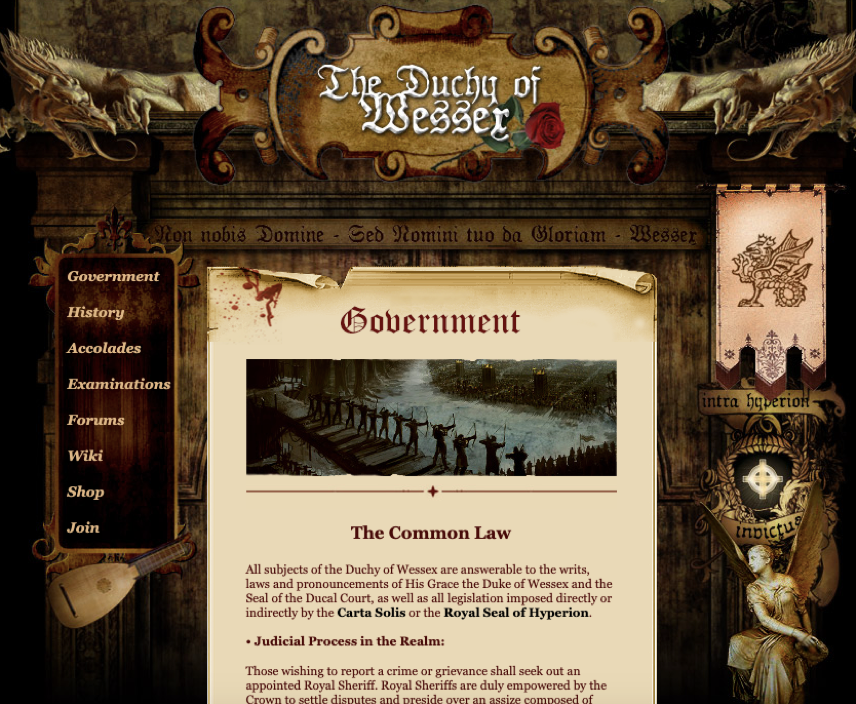
This is the story of a legal system evolving inside a video-game. It began with the English feudal system, and ended with something alien and strange. The setting is Darkfall Online, a medieval fantasy MMORPG which ran between 2009 and 2012, and then from 2012 to 2016 (as Darkfall Online: Rise of Agon). For much of this period, large portions of the main server were dominated by a group of hardcore roleplayers called the “Duchy of Wessex.” This group, led by King Manus, constructed an elaborate pseudo-feudal system, comprising a Royal Church; Shire Court; Chancery; Treasury; trained clerks; royal history; legislature (‘House of Lords’); and incredibly in-depth constitution (Carta Solis). You can still get a flavor of their work from their forums here.
None of their institutions or laws were part of the game features; it was all socially constructed by the Duchy of Wessex role-players. When I interviewed King Manus he suggested he was engaged in 'practical roleplay': by structuring a class system with various ranks, paid soldiers, and routinely collected taxes, the Duchy could outcompete rival guilds. And it succeeded in this: for most of the game’s short life, King Manus was the lawful ruler of the continent. One of the strangest aspects of King Manus’s rule was that it copied and pasted English feudal law into its courts. Thus, a legal system designed for a physical world was transplanted into one without death, pain, or physical bodies. What happens when you charge someone for murder without the existence of death?
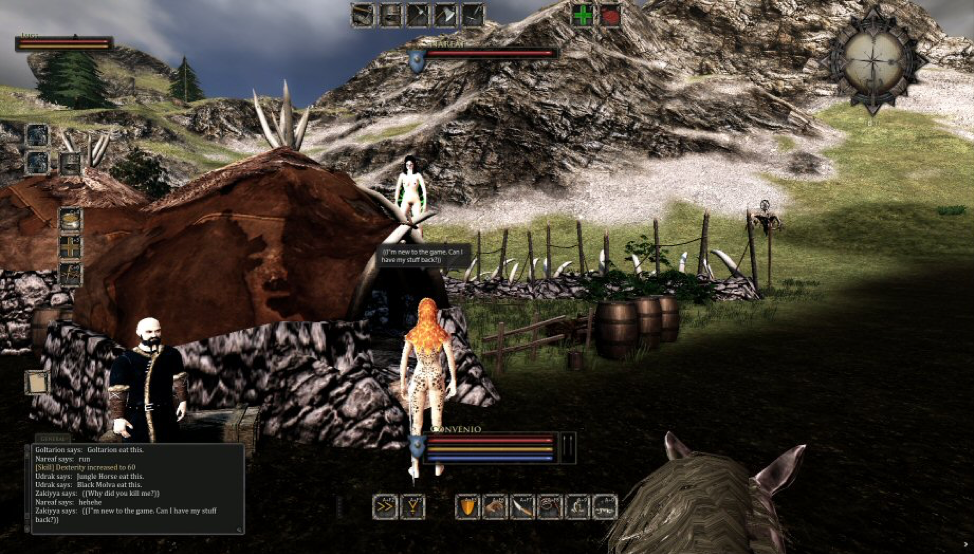
Let’s take an existing legal precedent as an example. On the 18th march, 2014, Faeran Stonewall was brought to trial for the murder of Zakiyya Ajam. The primary witness was Zakiyya himself. The problem with concocting a murder plot in a video game is that after murdering and robbing your target he will respawn shortly after. In The Assize of Faeran Stonewall Zak testified against Faeran and provided screenshots of the comments she made in the global chat after killing him. As a result of Zak’s immortality, the law of homicide was transforming into something unrecognisable.
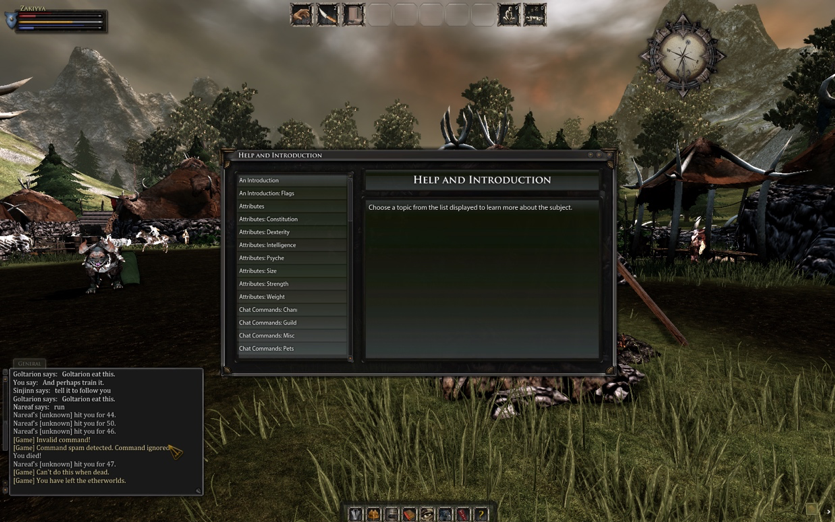
According to Wessex law, Faeran was properly convicted with ‘aggravated battery’, supposedly a ‘type of killing offence.’ Any medieval lawyer would tell you this is confused and conflates causing injury with killing. But can a killing-offence without death even be called killing? Their discussion over battery was similarly distorted. Had Faeran been charged with simple battery she would have faced a comically lenient penalty. Throwing mana missiles, assaults with weapons, or just generally being ‘annoying’ in other ways, were subject to a small fine (50 gold coins!). But on reflection this also makes sense. In a world where health ‘regens’ automatically, and pain does not exist, is any injury serious?
‘Murder’ and offences against the digital person must be referring to something else. With a bit of investigation, the underlying logic can be distilled. Wessex crimes drifted away from protecting ‘the body’, with its social and emotional significance, and instead moved towards the harm of inconvenience. Resetting a character to their starting position, stealing their items, causing noise and being disruptive – all of these relate to detracting from a full experience of game. In a video game the basic good is not life but fun. Thus, the quintessential wrong is not causing death, which is a mere inconvenience, but hindering a player’s enjoyment.
The principle of enjoument helps explain other anomalies in the Duchy’s substantive law. Given the triviality of death, many barbarisms were permitted which would destroy a real community. The provision for manslaughter, for example, read: ‘Bringing someone to death through a random attack without discussion first is a fine punishable by 500 gold.” Provided the players have a responsible discussion, ‘killing and looting’ (in private) was perfectly legal. The law of self-defence was also very strange. Given magic was a game mechanic, what was ‘reasonable’ was more open to interpretation. Thus, in the Assize of Faeran, Faeran argued “He looked naked but you can never underestimate those naked mages if he was one”. Or, Zak, in response to Fae’s accusation that he didn’t mark his allegiance properly, gave the amazing defence that ‘I’ve been away from the game for several months.’ What is this defence? Zak was arguing here that there should be a ‘newbie’ defence. We are thus introduced to a bizarre new legal creature.
A newbie is not equivalent to a child, possessing moral capacity, nor are they similar to a madman, someone in a trance, or person acting involuntarily – they are fully conscious and autonomous. The only analogy which comes close is someone who wakes up from a coma and forgets all the laws of physics, including gravity and how to move their limbs. Do they deserve a defence for some otherwise illegal actions? ‘Your honour, I only threw that fireball because I didn’t know what the ‘S’ key did’. Even then the analogy is weak; in the context of role-playing a legal system the defence of ‘newbie’ breaks the fourth wall. Yet clearly the ‘newbie defence’ cannot be ignored as ‘breaking character’: you want to encourage new players to stay in the game and can’t simply penalise them because ‘the character’ ought to have known better. There is a genuine policy dilemma between protecting players from newbies and ensuring a healthy player base.
After a five day trial, Faeran was eventually found guilty of ‘aggravated battery’ by the jury. Alas, this merely raised new problems. How do you punish someone without a body? The Duchy devised a series of ingenious ‘e-punishments’ to keep the (digital) streets of Wessex safe. Minor offences like hitting someone with a club or burning them with fire would be punished with a small fine and a mark against the players name. If the crime was more serious, the culprit might be subjected to forced labour (harvesting wheat) or made to run around a fixed perimeter for a period. Or, if even more severe, they might be put in digital stocks before the community of Wessex. The enstocked perpetrator then would be taunted by other players, roleplaying the throwing of rotten fruit and hurling general insults. The ultimate e-punishment was execution… and then exile from the Duchy of Wessex. Again, we see in these punishments no infliction of pain, but attacks on other, different pressure points of the accused: their reputation, identity, inclusion in the community, and enjoyment of the game.

But we can go deeper. What if the culprit creates a new account to evade justice? In an interview with the author, King Manus suggested IP address tracking would solve this problem, but it is hard to see how tracking by a casual could get around VPNs. This unexpectedly touches on the most destabilizing element in the entire Wessex legal system: the emerging digital person. The question was raised squarely in The Assize of Darithos the Seaman: what crime, if any, is hi-jacking the account of another player? The court initially charged Darithos with ‘theft’ and harassment’, but due to his non-appearance after four days the court ruled against him without a reasoned judgment. We should challenge their ambiguous framing: players often invest significant time and self-esteem in their online personas – would the case have been the same had the thief used the account to debase the character? For example, making the character engage in explicit, perverted sexual acts, or ruining their character and reputation in the public forum? How do we treat an item of property with this level of personal and practical agency?
One answer is that each separate account is a ‘legal person’, making the human player the president of a miniature state. Another is to treat each player as a legal person, a consciousness with many individual ‘limbs’ in the form of accounts. This would be an alien legal creature: a mind capable of existing in multiple places at once, with many bodies acting in concert. Then, going further still, when the Duchy began spreading to other games would this have meant the player also extended his limbs across the different worlds? How do we adjust punishment from game to game when the laws of nature and moral conventions change? The Duchy of Wessex, before it was destroyed by the homophobic and anti-Semitic Coalition of the Chillin’, started to create ‘colonies’ in other games (like Mortal Online). What would ‘international law’ look like when the individual states have different laws of physics? Would we expect to see exchange rates – say between Duchy of Wessex gold and Minecraft diamonds? – and cross-game bureaucratic tracking of identity?
The questions go on and on! These are merely the first mutations which emerge in a video game legal system. The Duchy of Wessex ran for a mere seven years but massively distorted the feudal law seed; I think this was because the high-interaction, high-event focus in video-game design created a legal system with a rapid metabolism. Even though players might only log on for a few hours a day, they expect constant stimulation, and thus produce constant opportunities for legal conflict. With longer run-time I wonder how deep the divergence could have become. How long does it take for legal evolution to totally eradicate outdated concepts - here, ‘assault’, ‘execution’, and ‘body' - and replace them with a set of new, better-adapted legal appendages?
Part 1 explored the relationship between the laws of physics and legal evolution. Part 2 will explore what happened when the Nazis tried to re-forge their legal system according to mystical racial science. Can ‘Germanic common law’ serve a modern industrial economy, or will the obscure laws of legal evolution inevitably return to the decadent Roman law?