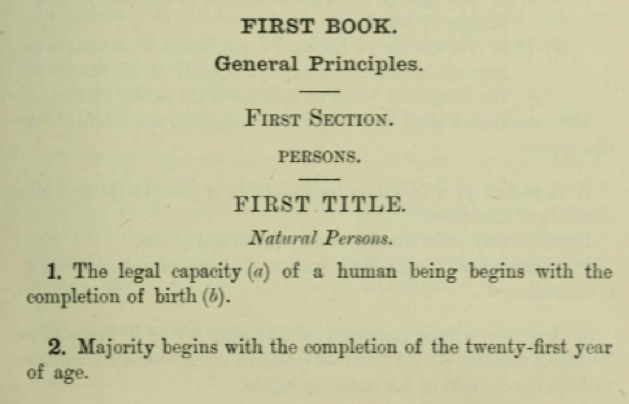
What happens when you transplant a racial legal system from the 10th century into a modern industrial superpower? Let's ask the National Socialists.
The first thing they will tell you is that Roman law is materialistic and degenerate. According to Nazi legal theory, Roman law is a tool used by the Jews to defraud the German people. In Hitler's 25 point plan for the NDSAP in 1920, for example, he made the following demand:
19. We demand the replacement of Roman law, which serves a materialistic world order, by German common law.
It might seem absurd that the Nazis cared so much about Roman law, but at the time it was a logical target. In the late 19th and early 20th centuries, law was much more closely intertwined with national identity and measures of 'civilisation.' The Nazi rejection of law was thus designed to strike at the roots of the modern Europe, and no legal system was as legally civilised or sophisticated as Weimar Germany. Pre-1933 German law was famous for its rigour and detail; when a new German legal textbook came out it would be quickly translated into French and English. Many considered German legal science the highest form of Civil law, a pan-European family of legal systems sharing a common ancestor in ancient Roman law.
For many legal scholars and political scientists across Europe, especially those from Germany, Roman law was the embodiment of reason and civilisation. This impression was strengthened in the late 18th and early 19th centuries as German legal scientists manipulated Roman law to serve the needs of high-volume, high-velocity commodity markets. You did not speak of Lords and Tenants but Legal Agents. You did not speak of a particular relationship between priests and regional merchants but legal contracts between A and B. A could be anyone: a man, woman, Frenchman, Italian, Jew, or company. Equality was guaranteed by the formalism of Roman Law.
The Nazis did not like this. They wanted a legal order which reflected the 'true spirit' of the German Social Organism, and the quickest road away from Rome was to resurrect racial legal categories. Karl Larenz, the chief Nazi legal scientist, proposed a new system: legal capacity would belong to the Volksgenosse (ethnic kinsman), whilst the Fremde (outsider) would get a derivative form, if any. Larenz also distrusted the abstract concepts (begriffe) of the German Legal Code, Bürgerliches Gesetzbuch (BGB), because of their impersonal logic. A BGB definition might go something like this: if there is (1) exercise of will; (2) made objectively manifest; and (3) a subjective meeting of minds between two individuals, then there is a contract. Disgusting! Where is the life?
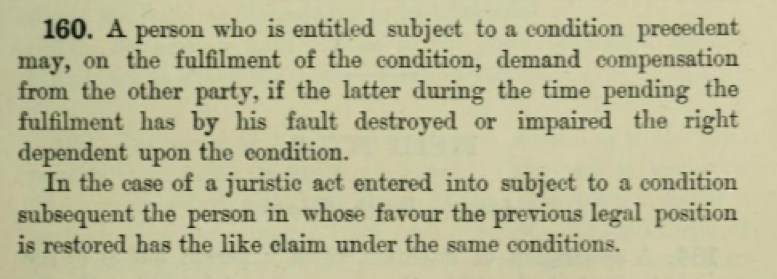
Larenz, like Carl Schmitt, believed the begriffe were ossified and artificial. He wanted a system which would trace 'true living conditions' of the German social organism, a technique now known as Concrete Order Thinking (COT). With COT you replace begriff with specific types (typus). No more logical 'IF-THEN' formulae: instead, you find a typus, say 'The German Worker', or 'The German Householder', ascertain its organic role in the Germanic social organism, and then work out how immediate cases relate. Is the agreement serving the spiritual and moral needs of the German superorganism? The only problem with COT is that, by its nature, typen are not generalisable. How do we know what the organic relations of society are? The Nazis believed they were hard-coded into the blood of the ethnic Germans. Like many unfalsifiable claims, this assumption contained fatal weaknesses.
Take the Nazi Volksgesetzbuch (people's code) as an example. It was initially designed to replace the 2385 paragraph BGB with a shorter, more accessible alternative. One difficulty: although the typen were notionally intuitive to the volk, the law professors felt it might be necessary to clarify what the organic relations were. In every single case. Thus, the people's code rapidly ballooned from an accessible 400 paragraphs to a vast 3000, and then, soon, absurd five-figure lengths, filled with non-technical 'confessional', 'evocative', and 'sweet' morsels of ideological declaration:
People's Code, Grundregel 2: German blood, German honor, and hereditary health are to be kept pure and preserved. They are the fundamental forces of German Volksrecht.
People's Code, Grundregel 20: He [the judge] renders justice according to free conviction and according to a legal interpretation sustained by the National Socialist worldview.
It turns out it is hard to produce a legal code if you reject formal abstraction and logical systematisation . The Volksgesetzbuch was thus never completed and sank into obscurity. In its place, the accursed Roman-riddled BGB continued in operation. But how long could it stay pure? Could the fine elegancies of Roman law survive contact with a court system tasked with the extermination of 'race traitors?'
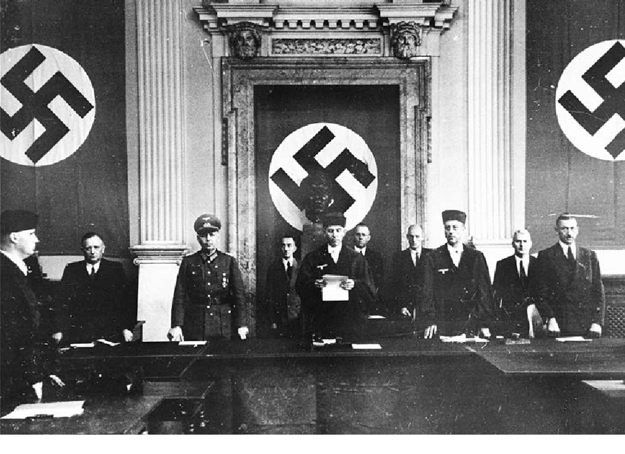
The detailed statistical evidence of how Nazi courts worked remains mostly unanalysed, but we know they handled huge business (2.2 million civil cases a year), and get a sense of their practice from published cases. The most influential account is by Ernst Fraenkel, a Jewish labor lawyer who practiced law in Berlin until 1938. According to Fraenkel, the Nazi legal regime was a Dual-State system with two co-existing legal states. The Prerogative State operated with unlimited arbitrariness according to the political demands of the party. Attempts to challenge an arrest or act of political violence would be futile within the prerogative state. The Normative State, in contrast, was orderly, predictable, and structured by formal rules. An errant debtor's argument that compound interest was a "Jewish device contrary to Nationalist Socialist thought" would be dismissed out of hand for lacking a legal basis. This uncomfortable, somewhat schizophrenic fusion inspired Fraenkel's famous quip:
[This is] a country in which it is possible that a concentration camp inmate can successfully file his tax complaints
Why did the Nazis bother? Why insist on due process if you have absolute power? The most extreme National Socialists demanded the old formal law be abolished as a tool of the Jew. But cooler heads prevailed: full race-law would never work. Until the planned wartime economy, the Nazis left most industries in private hands; it was, in Nazi-terms, a 'state-directed market economy' mixing massive state investment with private profit-maximisation. Regardless of racial ideology, National Socialism still needed a functional market, and the typus theory was too unpredictable. And for a market, the Nazis needed the old BGB principles: freedom of enterprise, sanctity of contracts, private property, the right of the entrepreneur to control labor, and protection of interest agreements.
Larenz's program of Concrete Order Thinking imploded, and the inner logic of capitalism triumphed over Nazi ideology. Almost. Nazi jurists did successfully transform one fundamental legal concept: legal status. It began with an ordinary case. In 1933 a film company signed a contract with a Jewish cinema stage manager containing a clause which permitted termination if "sickness, death or similar causes rendered the stage manager's work impossible." The highest German court decided in 1936 that simply being Jewish was sufficient to establish a finding of sickness. Then, in 1938, the decision was fully generalised: a court ruled the Jewish population had no legal personhood, for if they did:
[i]t would not be permissible to interpret the law to the disadvantage of the Jew and the Jew would enjoy the protection of the law. It is obvious that this makes no sense.
The Jewish people were permanently confined to the Prerogative state; Fraenkel called this his 'civil death.' In theory, modern legal science was supposed to preclude such barbarities: in theory Roman law is perfectly self-consistent body of rules necessarily entwined with morality. Natural lawyers had been making this claim for centuries: it was the nature of God's written reason, ratio scripta; it was the logical deductions from secular reason; it was the common inheritance of the British people. The tragedy for these authors is that the Nazi race-laws had no effect on the coherence of its private law. 11 million civil cases could go through the system in 5 years without a wrinkle. It turned out law was a lot more like mechanical or chemical technology than literature or religion.
The hybrid Nazi system suggests that legal rules are driven primarily by functional pressure. If you want a functioning market, you will need something resembling Roman law. The communists used Roman law for their 1923 Civil Code to regulate the New Economic Policy, as did Apartheid Africa in the 1950s with their 'Common Law A' (Normative, White) and 'Common Law B' (Prerogative, Black). Politics and geography are apparently irrelevant: the Meiji Japanese reformers imported Roman law in 1898, the Turkish modernisers in 1926, and the stubborn Victorian common lawyers in 1840. Any hope these rules might contain an inner morality has been crushed by the weight of history. We no longer speak of elegance in law, or praise its beauty and truth. Law, like economic engineering, and energy infrastructure, has been reduced to another technical system of modernity.
Part 2 has explored what happened when the Nazis tried to re-forge their legal system according to mystical racial science. Part 3 will examine the most English of practices: retaining ancient customs far past what is reasonable or sensible. How long can you sort your law purely alphabetically, and how long can a system designed for the 15th century survive into the industrialising 19th century? And most important of all: how long can we keep wearing these wigs?