Author: Yasunari Kawabata
First Published: seralised 1938, published 1951
Genre: fiction, short-story
First Published: seralised 1938, published 1951
Genre: fiction, short-story
A sad story about Hon'inbō Shūsai’s last game of Go (1938) and the changing of the seasons.
There are many reasons to play a board game; as far as the Go players before-1920 were concerned, winning was not one of them. Or at least, it shouldn’t be. Kawabata was the last Champion of this halcyon era.
Go, according to Kawabata, has other virtues. First, as a symbol of respect for the dignity and humanity of other beings. Although we may be divided by the irrelevancies of race and the petty historical accidents of nation, all humans are equal before the 361 squares. The dual both sides take seriously is a solemn affair. In its high form, it is a recognition of the Other as your partner in a sacred ritual; in its low form, it is the intimacy of a knife-fight:
War is the ultimate game because war is at last a forcing of the unity of existence.” [Judge Holden, in Blood Meridian, Cormac McCarthy, 1985)
Second, Kawabata speaks of the “fragrance of Go as an art”; of its beauty; and of the ultimate goal of both players being to produce a “masterpiece.” Kawabata is disdainful of the new players who treat Go as a “contest and show of strength” only. This is a fundamental tension in sport: between the beauty and excitement of the sport and whatever weird grotesque monstrosity emerges from the optimisation process of iterated tournaments. It is there in the unseemly vee-style ski-jump and the Fosbury flop, in the stodginess of base-line play of 60s-80s tennis, and the yawn-inducing reality of sabermetric-era baseball. What happened to the “finesse and subtlety of the warrior’s way”? Where did the “mysterious elegance of Go as an art” go?
Third, and most crucially, Go as a “way of life...” For Kawabata, Go was not merely a Game, not merely a ritual, not even an artform: it was one of the paths of life. And this way of life was traditional, comprising respect for one’s elders; ancient, unfair prerogatives for the “Master”; of affectionate, obedient disciples; of the Great Four houses of Go, and of invincible legends.
Where did this world go?
A crucial task for any community is to determine questions of prestige. Who is to receive the honour; who gets the community’s esteem; who is to receive the publicity; who receives the material benefits; who gets the accolades, titles, and other symbols; who is recorded in history and remembered by posterity; and, most crucially of all for the athlete or player, who gets to play in the tournaments?
Today, we resolve these questions through a formal contest to determine “who is stronger?” Who receives the prestige?: whoever wins the matches according to the formal rules of the game or sport. Kawabata was writing just as this social technology was emerging. He complains of Go being reduced to a simple contest of strength; that Go “tended to be controlled these days by inflexible rules”; that “the modern way was to insist on doing battle under conditions of justice, even when Challenging the master himself.” The result?
The master was plagued in his last match by modern rationalism, to which fussy rules were everything, from which all the grace and elegance of Go as art had disappeared, which quite dispensed with respect for elders and attached no importance to mutual respect as human beings.
From the way of Go, the beauty of Japan and the Orient had fled. Everything had become science and regulation.
Kawabata's tale is seductive. Hon'inbō Shūsai, the 21st hereditary head of the Hon’inbō house and the last recipient of the ancient honour of Meijin, was old and ill at the time of his match. Nevertheless, he was forced to play on a tight schedule for the sake of probity; sealed in a ‘tin can’ to prevent him conferring with others; and denied the ability to adjourn when he needed to. “Little thought was given to the evils” of these rules, for they were governed by “a rationalism that somehow missed the point.” The strict rules of sport and game in which winning is everything become inhuman: the constant temptation to dope; in the massive psychological and physical cost of competition; the perverse destruction or distortion of athlete’s bodies. And for what? Mere victory?
If we reject this fair but cruel system, how do we allocate prestige? The old system of Go was dominated by four houses of Go, Hon’inbō, Hayashi, Inoue, and Yasui, of which the first was the strongest and seemingly most important. The head of that house at the time of the match was Hon’inbō Shūsai (having taken the name as an honorific) and appeared to exercise a kind of despotic (regal?) power over the Go community. He would decide disputes in games and in the rules; he could adjourn his matches whenever he pleased; he refused to play Black. On one reading the Master of Go is just a long series of attempts to placate, cajole, and persuade Shūsai to play fair in his last tournament match.
How the head of the Hon’inbō house was decided is entirely opaque: when Shūsai dies Kawabata states no way of determining his successor had been agreed. As far as I can tell, his position came to him through personal connections in the Hon’inbō house (most likely, through Hon’inbō Shūei, whose favourite had just died unexpectedly) combined with his Go ability. His authority was entirely Charismatic in the Weberian sense: he exercised it through the force of personality and, until his last match, could run over any formal rules he did not like. The closest analogy in my own life I can remember is my PhD supervisor, Professor David Ibbetson, who exercised an entirely anachronistic and remarkable de facto power in the Cambridge Law Faculty. When a formal rule might bind him – such as a deadline, funding requirement, or the small matter of the Legal History room in the new law faculty – an exception could always be found.
Most importantly, the title was not a mere matter of winning tournaments. In fact, the head of the household, according to Kawabata, would rarely play games at all (and had they been required to, Kawabata notes, would have likely lost their titles). Instead, his title was awarded purely on the basis of the opaque and somewhat mysterious inner-workings of the Go community elites. Kawabata disdains the new system in which the title of Hon’inbō is becoming (and by 1940 had become) merely a mark of strength, a commercial asset, a ‘victory banner’, rather than a sign of utmost personal and professional virtue.
The world of pre-1930s Go was therefore a human-sized one. It resembles pre-1800s world of English law; the parallels are so striking that it suggests a general pattern of oral communities. In 1750, English law comprised a small community of judges (12), who received their places on royal patronage with support from the elites of the legal community, would decide contested legal cases according to a mixture of good sense and the “subtle science” of the common law. It was opaque, sometimes self-consciously so (the common law being regarded with pride as an art with deep mysteries); the outcomes of cases were often ambiguous, fuzzy, the matter of shifting, nebulous collective opinion rather than formal correctness; and the titles, honours, and so on, were awarded both on the strength of a lawyer’s legal ability, as well as their perceived integrity as a gentleman.
These historical forces met in a rare inflection point: Hon’inbō Shūsai’s match against Kitani Minoru in 1934. Shūsai – the titular “Invincible Master” of Go - was born in 1874 and died 1940: accordingly, he lived through the Meiji, Taishō, and Showa eras, and thus, in Kawabata’s words, encompassed the full sweep of history. In his person was concentrated the last great titles of Go and following his death these titles fell into desuetude.
In contrast, Kitani Minoru was a man who grew up in Taishō and Showa, but lived through them to the other side of WWII. Of the highest 7th rank, Kitani was an innovator of the game, inventor of new openings and populariser of Go publications: along with Go Seigen “the founder of modern Go.” A man who taught his daughters Go and was a genius at the centre of a circle of earnest friends determined to change the game.
Their match reveals the powerful currents against the Old World of Go. Kitani insisted, with the support of the new Go Association and the younger players, on several formal procedures: sealed moves for the last play of a session; time limits; and fixed days for rest and play. Why might he have insisted on such procedures? Because, in Shūsai’s match against the greatest Go player who ever lived, the Chinese-Japanese prodigy Go Seigen, the “Invincible Master” repeatedly abused his seniority prerogative of adjournment. 18 times he adjourned the play right after Seigen’s play. Each and every time, he used the opportunity to plan in great depth, sometimes – it was claimed – with the help of his students. Kawabata euphemistically calls this his ‘traditional wilfulness’, borne out of a world in which he was subjected to such abuse by the Master of his era. They were:
[T]he arbitrary ways that had been allowed the Master had forged the Master’s art, incomparably superior to the latter-day game and all its rules.”
Yet the “master could not stand outside the rules of equality” and faced a community unwilling to tolerate such patent unfairness. You can hear Kawabata lament that such stringent, mistrustful rules are required, of the moral-decay which renders them necessary. What happened to the Old Japan of Gentlemen, wherein a man’s agreement was his bond; where the shared ideal of greatness and excellence link the great, good, small, and lowly in a single pursuit. Where Great Men and Legends exist (the “Invincible Master”, joined by the 13th in line to the Grand Masters of Shogi; a Master of Shogi; and Master of Renju ), and where, in person, they are aristocratic, distant, awesome, and eccentric?
After long hours of play, the Invincible Master is defeated. It is the final triumph over a new world of bureaucracy, formalism, equality, and temporary, paper champions:
[T]he defeat becomes the defeat of a tradition. It is the aristocratic tradition which, until 1945, was the ground for morals and ethics in Japan, and for the arts as well. Just as Mr Kawabata would have nothing of jingoistic wartime hysteria, so he would have nothing of the platitudinous “democracy” and “liberalism” of the post-war years. (E.G.S.)
It is the crass world that Kurosawa disdained (in Madadayo), that Capra feared (in It’s a Wonderful Life), and that Churchill diffidently accepted, whilst inwardly and naively believing the old world of legends could be ressurected with fascism (in Mass Effects).
Yet reading between the lines, it becomes apparent that Shūsai himself was a source of decay. In the words of the editor, it is difficult to make out the Master as he really was in Kawabata’s elegy. It is, in truth, the elegy to an ideal, not a person. For the man himself was deeply flawed. His greatest flaws, characteristics of his era, were the pathetic and depressing flimsiness of greed. He sold his title to the Go Association to “buy a big house”, only played the final game because a newspaper (Mainichi Shinbun) sponsored it with a huge amount of money; and travelled to China for huge fees to play games, only to leave matches unfinished when he might lose to younger Chinese players. Go Seigen, in later years, described him a "scoundrel" and a "villain.”
What killed the Good Old Days of Go then? The same things which killed the halcyon era of English Law.
Should we mourn the death of Old-Go? Something has been lost, a loss familiar to the sports fan and 1930s Go player. It is the disappearance of legends, of a time when the game was beautiful, when it was played for its own sake, and when money did not grease every goal scored or win eked out. Of a time when the sports community would accept a college football tournament could produce no decisive winner (the fans choosing their favourite); of anachronistic colourful traditions like the Tour de France “café raids”; and when the players were familiar locals, or men of character, rather than the anonymous hot-housed mechanisms we see today. Yet a consensus cannot survive when the community outgrows it, nor can the semi-arbitrary selection of players persist. Above all, our mountains, our mythic players and titanic clashes, the legends, cannot live in the harsh light of objective scrutiny. Shūsai might simply be filling the uncomfortable place of the Saint in the Modern World: the last miracle from a time of poor records, low legibility, and high mythology, now exposed to the harsh light of criticism, fair contest, and hyper-legibility.
Miracles and legends cannot live in these conditions, the glory days wither under such scrutiny. The last legacy player – the “Invincible Master” squinting and crooked before the harsh gaze of the new world.
And yet new life emerges. Kawabata believed there was “new vitality in the World of Go”, with new openings, new play-styles being discovered. It was only with the discipline of formal equality – of ‘playing to win’ that the Game could develop and evolve. The optimisation process of the tournament, whilst producing degeneracy and ugliness, also produces progress and change. What might feel like an era of depressing stagnancy could transform into a New Golden Era: all it takes is a few lone geniuses who can push the game forward. And for those who care about the frontiers of sport, such competition is essential. When hundreds – thousands – of top level games are being played daily, and when there are scores of elite players, could we tolerate the slowness and drabness of an old artform’s fixed ‘beautiful moves’? Go might have fallen the way of Aikido: a beautiful but entirely ossified sport unrelated to physical prowess or an actual contest. Such a steady state is unappealing for the modern player:
Theirs is the feeling generated by abstractions writ large, by the shock of scale and contrast, by the sensationalism and spectacle of the new and the bizarrely transfigured – a totemic architecture of novelty. Eisenman's architecture turned out to be a perfect fit with a late-industrial society seeking ever more thrilling forms, new assemblies, alien geometries – all permutations of the same limited industrial vocabulary. (The 1982 Debate Between Christopher Alexander and Peter Eisenman)
The hope is that the optimisation process will continue to iterate, under the elegant formal conditions of the game, new and exciting developments. We hope the game itself has enough inherent ‘generativity’ to produce endless permutations.
On the one hand we have Order presented as something subjective, socially-constructed, with the flavour of repression about it, and on the other Order as something objective, a fundamental property of matter, something essentially generative. (1982 Debate)
But maybe it is still a matter of volume: what happens when the optimisation process itself, again, saturates? When the Game hits a human limit: of hours training, of human endurance, of human speed, in body and mind? We see it in Chess; in Law; and in athletics. Will all sports and games tend this way – will all contests plateau? It may be that, for any sport or optimised contest, there is a ‘Golden Era’ of low-hanging fruit, picked plentifully in a world which still retained slack, and a “Grey Era” of ever more marginal gains.
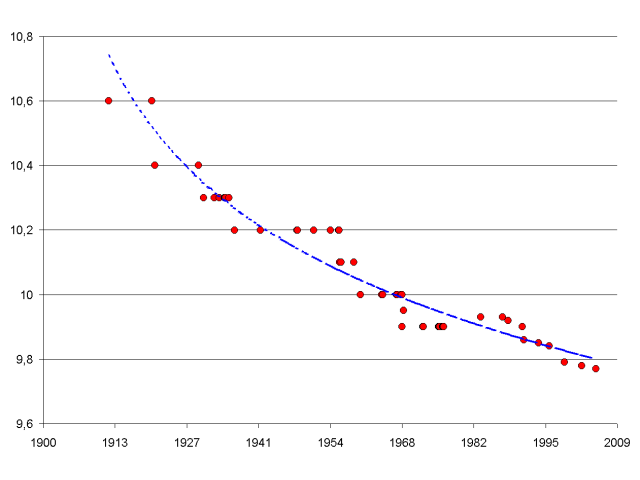
Progress in 100m sprint
What determines the inherent generativity of an activity – makes Table Tennis apparently more stable than tennis, and the 100m sprint more stable than boxing? Makes Mixed Martial Arts the ultimate modern sport, more fluid, unpredictable, and creative than any other? Can it be offset by new equipment, by new rule changes – by the careful hand of the central planners of the Sports or Game association technocrats? Can they engineer our sports to produce a still-recognisable human-sized stage, one fit for our stories, just able to pop up, now and again, in the space left by money, dehumanising training regimes, and endless optimisation?
Can legends exist in the Grey Era?
And who is to say this resting point will be remotely human in shape? We hope naively that the winner and the “good man” will be one and the same person. And yet they often are not: the winner is a grey blur, or the optimal form of play is boring and conservative. We are anxious that whatever it is that gives a legend colour will be outcompeted away under optimisation.
But who decided that?
~