Author: Genzaburō Yoshino
First Published: 1937
Genre: non-fiction
First Published: 1937
Genre: non-fiction
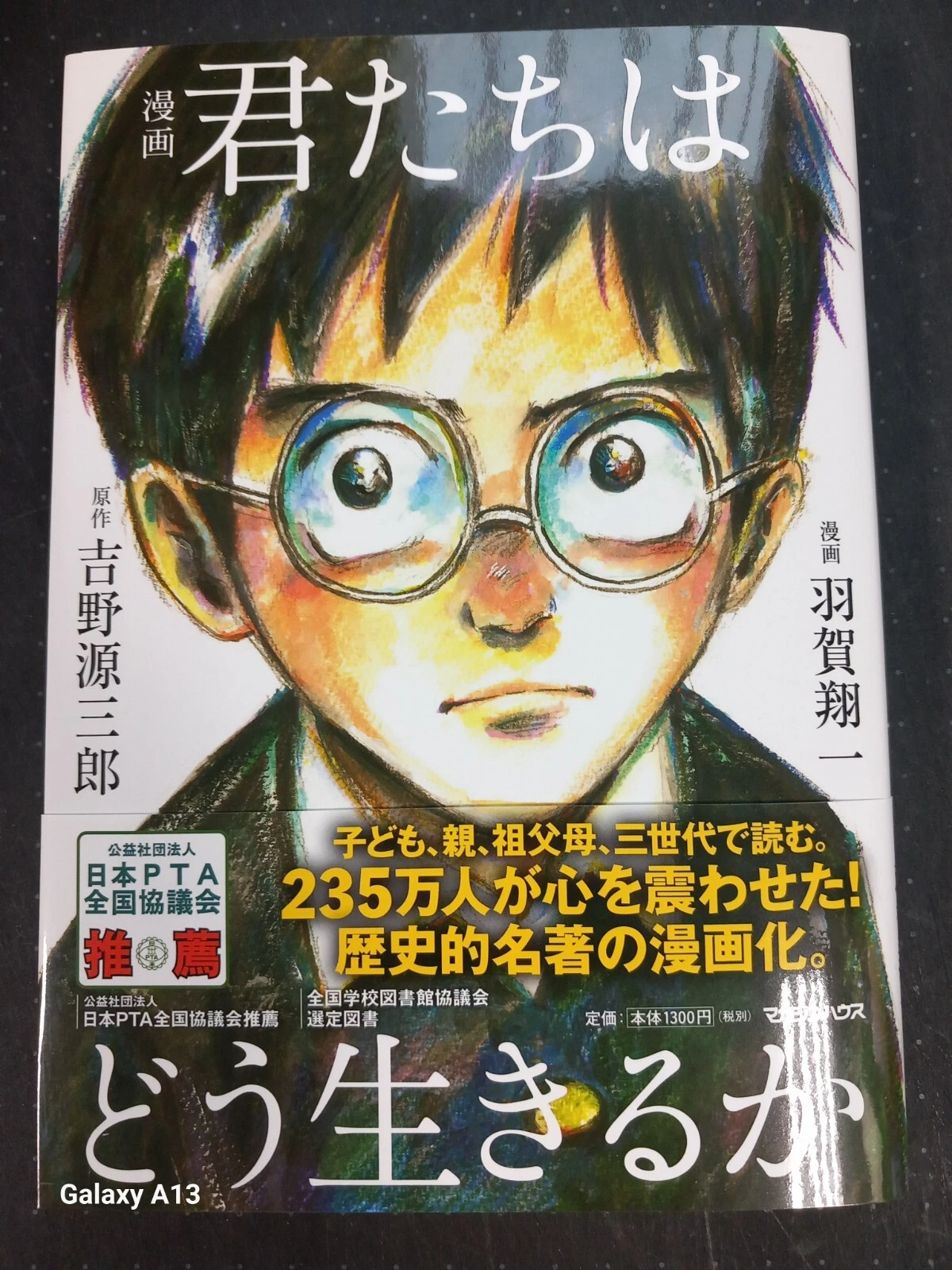
On the surface How Do You Live? appears to be a relatively harmless if condescending dialogue between a young boy (15) and his uncle (lawyer) on various moral topics. The latter bangs on about ‘being a truly good human being’ in the context of bullying, wealth inequality, and loyalty. It has some interesting points to make – as an artefact of the 1930s it covers familiar anxieties about the scale and size of society (relying, for example, on so many ‘inhuman’ relationships with strangers); the amazingness of technology and progress; and the importance of maintaining dignity and spirit in the face of human poverty. In this way, it is quite similar to Capra’s It’s a Wonderful Life and Mr Smith Goes to Washington.
But wait, did you say 1930s Japan? This book has a ghostly sequel which was never written. In that sequel – set two years later – the young boy (nicknamed Copper after Copernicus) and his friends have grown up and are fighting for the Imperial Japanese Army. In that army they do terrible things and have terrible things done to them. The chances one is going to die by the end of the war are almost certain. This is no surprise to them. In the first book (1937), Japan is already a militaristic, authoritarian state, responsible for the colonisation of Korea and the invasion of China. So you may ask why the uncle is giving his nephew bland advice regarding typical childhood dramas rather than – say – the impending war, repeated assassination of liberal prime ministers, and all-encompassing religion of the Emperor? I am not sure. One possibility is that these mature themes were removed given its intended audience (young children?). I think this is unlikely – the book is aimed at 15 year old boys who, as noted above, will be conscripted in two years. The author could have mentioned glorious battle, the Japanese imperial project, and the importance of defeating Japan’s enemies. Indeed, other books aimed at young adults in Showa Japan do exactly this (and, for that matter, in most other countries in this period). If anything, there would have been pressure on Yoshino to include exactly these themes rather than studiously skirt around them.
Instead, I think a more plausible reading is that Yoshino disagreed with what was happening around him. At first I thought he was a yes-man, and I was enraged: what, you want me to accept these lectures on morality by an upper-class, establishment Japanese man from the 1930s? That anger was all wrong. I learned later he was imprisoned for 18 months for socialist tendencies, and the book was eventually banned in 1942 by the imperial censors. I think a more nuanced reading is that the exclusion of these themes represents an act of regretful self-censorship. One so complete it is difficult to identify his political motive, or even date the events. If we read carefully between the lines, however, slivers of resistance emerge.
Copper’s uncle notes that the job of the prime minister is stressful and bad for the health. Very bad for the health: five years earlier, the prime minister and two liberal politicians were assassinated by ‘rogue’ ultranationalists. Or take Katsuko, the strong-willed sister of one of Copper’s friends who acts as a leader/mentor for them and is on the path to attending university. Her very existence is a minor act of rebellion (she is from a wealthy, elite family), forcing us into a liberal fantasy of 1930s Japan. In the second half of the book, the main antagonists are the ‘Judo Club’, a group of violent older students who discipline younger students for ‘excessive love of literature and poetry.’ The club gives angry speeches at assembly and justifies their actions on the basis that students with ‘no love of school’ will grow up to have no love of their nation, and will therefore become traitors.
This is where the book gets a little odd. According to Copper (or some other narrator?), the problem with the Judo club was not their ideology per se but that they had made of their minds obstinately and were deciding to punish on their own behalf, independently from the school. This apparently stirred up trouble of its own by making the students ‘tiptoe in fear.’ In doing so, the ambiguous narrator notes, ‘weren’t they inadvertently making it into a place that was hard even to like?’ How do you say you dislike your ultranationalist country without saying you do?
Around this time, the uncle ceases to give specific advice to Copper – in fact, he barely comments on the Judo club at all. At most, he discusses European history at length (slightly irrelevantly) and when he comes to the British Empire he mentions they ‘had to rule India’ opaquely. Why these tangents and evasions? I suspect because Yoshino (who trained to be a lawyer) cannot have his stand-in – the lawyer uncle – honestly comment on the club whilst remaining politically correct. So we get the rather bizarre outcome that their ideology is never commented on as wrong or right – rather, we focus on the procedural point that they were wrong for making decisions which belonged to the school. This is slightly baffling because, at this time, schools were jingoistic (not to mention, like all schools, authoritarian in structure) making them a poor metaphor for an idealised liberal government.
Yoshino was able to hide his true views well within this confusion. In fact, perhaps he hid them too well. The book was a bestseller the year it came out; he was accepted by the institutions of the day (he published for the national newspaper and attended the University of Tokyo), and it took five years for the censors to decide it was unacceptable. In short, if it had political barbs, they were so blunted that an imperialistic public could enjoy the book without feeling any sting.
There are signs Yoshino was aware of this compromise. Our young protagonist Copper watches, paralysed as his closest friends are beaten by the judo club. This is despite their earlier promise to defend each other no matter what. He witnesses them hold one another under the onslaught, even dropping the snowball he was holding so as to appear harmless. They walk away, closer and united. Afterwards Copper is wracked with guilt and becomes ill.
He agonises: “ah, if only Copper’s friends could know how he felt then.” His uncle visits and chides him for despairing. He urges him to have courage and apologise to his friends by letter. Copper does so, apologising and expressing how badly he feels – how he does not expect forgiveness:
“Dear Kitami,
When you were caught by Kurokawa’s friends, having such a hard time, I was there. I was watching silently the whole time. Mizutani and Uragawa didn’t run or hide, and I watched them go through the same hard time together with you. But I didn’t come forward.
I didn’t forget that I swore to stand with you if you were attacked. I remembered that perfectly. But still, I didn’t keep my promise. I think what I did was really, really cowardly.
I don’t know what to say to apologise to you. You can’t know how ashamed I am that I behaved in such an unforgivable way to you… I feel like a coward, or spineless, or whatever kind of hopeless person you want to call it. If you hate me or don’t want to talk to me anymore, I have no right to say a word. Only, I believe what I did was wrong, and feel so sorry that I can’t stand it. I think I would rather be dead. I just want you, please, to understand somehow that I know how bad I was.
I wasn’t brave, and I didn’t come out to support you. But I never felt for a second that I didn’t care about you. I feel the same now. I want you to understand my feelings someday. At least, I definitely want that.
This time, I promise I will try to be brave.
If you can, please try to believe that. If you believe that, I will be happy beyond words.”
That is… a pretty extreme letter for a 15 year old writing about a promise he made somewhat casually in response to hypothetical future bullying two months before the incident. I have no idea what Yoshino really intended by Copper’s letter, but I can’t help but wonder if it was really addressed to a different, living group of people. If we read it as addressing, perhaps, his old socialist friend, the letter takes on a different, far sadder meaning.
Following the letter, Copper’s mother comforts him after, saying that although he failed to act, he can still take it forward as a lesson to be ‘better and stronger’; his uncle notes in his typical humanistic, if somewhat grandiose style, that it is our regret and despair which make us human. Eventually Copper recovers from his ‘illness’ and meets his friends. He is forgiven entirely. They go back to the ways things were. The Judo club is punished and the snow melts.
He finds a spring onion with a meter long root, deep, deep in the ground ready to sprout when the cold recedes and the sun shines. In his heart, he calls out ‘well done, well done!’ his chest is filled with a good feeling. Afterwards, he returns to studying history and culture and we resume the pre-WWI feeling of the liberal world, where all nations are advancing together as one, on their unbroken, continuous journey towards humanity and knowledge. His room is filled with sun and a new day dawns. He writes:
“I think there has to come a time when everyone in the world treats each other as if they were good friends.”
This unsettled me and felt like a denouement. It was unnerving because I understand how Yoshino feels in some distant manner. I have often failed to do things I wish I had (‘what’s the kindest thing you’ve never done?’) and typically I try to take the edge off the disappointment with thoughts like ‘but I’ll learn to act better next time, so really it wasn’t a negative thing altogether’ or ‘but this regret is human and will make me more rounded as a person.’ Sometimes I believe this and try to remember the feeling when another moment of choice arrives. Other times, I neurotically worry that rather than acting as a single turning point, my inaction is more like the signs of a fatal flaw.
Not ‘my never-again failure’ but Lord Jim’s act of cowardice – not to be reversed but repeated because it is the most fundamental evidence of my character. Would Yoshino have acted differently if he could live again? I doubt even he knew: his dilemma was harder than Copper’s, not least because at the time of writing things were getting much worse and this nightmare would continue for several decades.
The feeling of denouement was different. I believe it is the sense of banality saturating the line about ‘all the people of the world being good friends’; of the cultural sharing and interconnection; and the idea of progress. It reads like the naïve copy-text found in libraries, high schools, charities, and world-traveller blogs in the 2000s urging us to become ‘citizens of the world’ – a group I had never considered to be the inheritors of the 19th century liberal’s dreams of progress until now.
This ideal feels naïve for many reasons: the rapaciousness of capitalism in melting not only national boundaries but also the day-to-day of normal, human life itself (not to mention the environment); the post-modern belief that each culture has its own value system which is (often) incompatible with others and cannot be reconciled into coherent progress or continuity; and the fact conflict, greed, and war continue no matter how much material progress we make.
All of this said, I prefer the fake liberal-Japan world of Yoshino to the present in many ways. Indeed, for all the reasons I like the fake-liberal world of Capra:
Forgotten among the hue-and criers were the hard-working stiffs that came home too tired to shout or demonstrate in streets ... and prayed they'd have enough left over to keep their kids in college, despite their knowing that some were pot-smoking, parasitic parent-haters.
Who would make films about, and for, these uncomplaining, unsqueaky wheels that greased the squeaky? Not me. My "one man, one film" Hollywood had ceased to exist. Actors had sliced it up into capital gains. And yet—mankind needed dramatizations of the truth that man is essentially good, a living atom of divinity; that compassion for others, friend or foe, is the noblest of all virtues. Films must be made to say these things, to counteract the violence and the meanness, to buy time to demobilize the hatreds.
And it reminded me once more of the subversive, rebellious nature of liberalism (!), which I forget again and again, because I have no memories of a pre-liberal world, and liberalism is too mainstream in European/US culture to be anything other than ordinary.