We are now more concerned about what young people are able to do, more concerned with understanding and skill and less concerned with the ability to regurgitate factual content. (Keir Bloom, Scottish curriculum reform, 2012)
It is easy to discount the value of ‘knowing things’ in education. Progressives have been attacking knowledge-rich curricula for decades. Its simple fact: a history course filled with key figures, dates, causes, events, and connections with other subjects is difficult – sufficiently so that a sizeable fraction of the cohort will fail its exams. The school curricula is supposed to be for the whole population, not just a ‘bookish minority.’ Besides, a course stuffed with knowledge is not only unfair but pointless. Who needs facts?
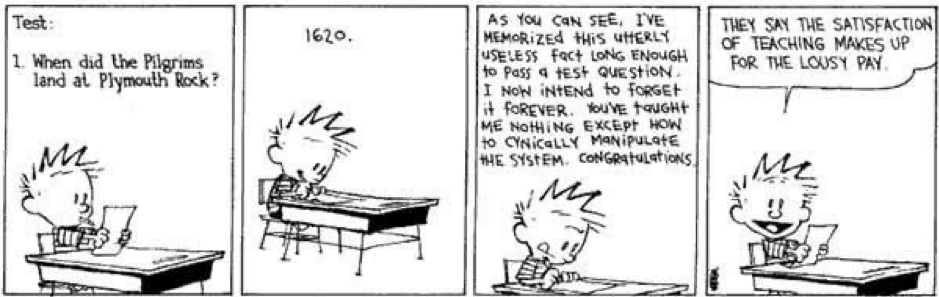
Meanwhile, from the right, skills-based educators reject memorisation because they claim it has become redundant in a digital age. Why bother memorising the landing of the Pilgrims at Plymouth Rock when you could just google it and pull out ‘1723’? These pragmatic arguments have been strengthened by the rise of AI, and it is highly likely we will see, in the next decade at least, a new cycle of stripping knowledge from school curricula.
But this is wrong. Not just because it would be inconvenient to know nothing, but for deeper, humanistic reasons. Let’s take the most fortified case for abandoning knowledge: say you can integrate an LLM directly into your brain and retrieve any of its knowledge instantaneously at the speed of thought. Now you don’t need to memorise anything: no more flash-cards, no more ANKI, no more spaced-repetition.
I think you would still be missing something important. Knowing things about the world makes your perception finer, which is a fine thing indeed. With knowledge, the world gains texture and depth: you will rarely go a day without seeing something in more dimensions. To give a simple example, as a child living in the countryside I often got to enjoy the vast architecture of offshore clouds. Yet these structures meant very little to me beyond a pretty picture. Then one summer, during the sailing season, an old man called Colin taught me their names and a little meteorology:
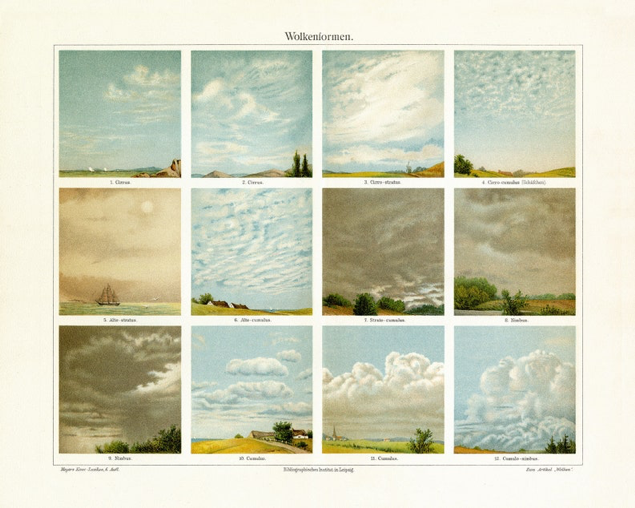
I can now distinguish the clouds and their weather patterns more finely. I understand how they form, where they are going, what they might portend for sailing in the afternoon. The sky is no longer a mysterious watercolour but a system of activity.
A different example, provided by my uncle, is spending a few weeks learning the different birdsongs. Now when we go hiking he can identify which birds we are hearing (and sometimes why), and the sort of habitats we are in. Somehow his forest has become richer than mine. Or, to give yet another example, I have a family friend who swotted the geological rock formations and their effects on Scottish flora. Now when we go sailing on the West coast by the lighthouse on Lismore he sees the vast Devonian mountains and igneous rocks of Balliemore.

Knowledge is a wonderful thing, both mysterious and enlightening. Perhaps the purest example is adding new words to your vocabulary. Discovering, for instance, the words immiserate, or panglossian, or bamboozle made my head a more interesting place to live. And when I learned the etymology of words, the blank plain of my language was suddenly illuminated. Why do dark and obscure feel so different? Or king and emperor? Or murder and assassination? Once, Scottish schools tested pupils on this kind of wordy knowledge. In the Scottish Higher Exam from the 1920s, for example, a 16 year old could expect questions like the following:
1. “The angles at the base of an isosceles triangle are equal”
2. “In a straight-edged three-sided shape having two sides of the same bigness the openings between these two sides and the third side will also be of the same bigness”
Compare and contrast these two modes of expression and state what conclusion you draw as to the function and value of (a) the Anglo-Saxon; and (b) the Romance elements in our English vocabulary. Illustrate further from the vocabulary of Medicine or Music or Grammar. (1926, SLC, Higher Grade)
You cannot distinguish birdsong without the words to do so, nor the ingredients in a meal, nor the genres of the cloudscape. The limit of your universe is the limit of your language. And so the student was drilled in precise meaning. The examiners sought to expand the verbal universe of the student, one word and one shade of meaning at a time.
2. Distinguish shades of meaning in – solemn, majestic, mighty, vast. Give the exact meaning of – concord, symphonies, pastoral, monotony, fret, rude, - as here used (John Ruskin, Panoramic in the Jura); add the derivation where you can (1927, SLC, Higher Grade).
All of this runs together in a rich mental web, filled with interlinked facts and observations in your day to day life. The examples I have given above are a part of me and at my command, structuring and filling my mental landscape. Each is connected to countless other points of knowledge, thus making new subjects more interesting and memorable; and each has subtle flavours from the various places and people I acquired them from. When I retrieve a new cloud shape, inexplicably, in some manner much more complex than I can express, a part of Colin and that lost summer come along.
Learning and facts need not be synonymous with ‘rote learning’, ‘dead facts’, or ‘regurgitation.’ To make knowledge come alive, as Alfred Whitehead once argued, all you need is contact with reality. Once you see this happen in practice, or feel the sting of knowledge’s absence, understanding its value is the simplest thing in the world. It is no more and no less than the child asking “what’s that?” and lighting up as you say “an oak tree!”