How do you find the author of an exam? For those who have not tried, finding examiners is a remarkably difficult task. Here is my attempt.
It starts with an unusual hobby: collecting examination papers. My collection includes the All Souls Fellowship Exam and East India Civil Service Open Competition, the S-Level (after A-Level), and the pre-war Tokyo University Entrance exams. But one is by far the strangest: the Scottish Certificate of Sixth Year Studies English paper. I first found it whilst hunting for mathematics examinations in the National library. Randomly, whilst flipping the pages, I came across the following:
Q.4. Write a poem about the walls you have built round yourself. (CSYS 1977).
What the hell…? Imagine sitting down for your final exam and finding this existential gut-punch. And Q.4 was by no means an unusual question. The examination was chock-a-block with existential and sometimes straightforwardly bizarre questions:
Q.4. There is an afternoon tea-party in progress in a respectable and well-conducted suburban house. Fifty yards down the road there is a figure, heading for that tea-party with destructive intent… Take the situation on from there. (CSYS 1983)
I decided to find the author. But where do I look? They don’t exactly write “Answer this impossible, personally devastating question, signed Ronnie Pickering.” I had to go deeper.
The first step was doing some basic reading about the history of the exam. Unfortunately, very few people have written about the CSYS. One exception was The Scottish Sixth published in 1976. Back to the National Library. Naturally, The Scottish Sixth did not mention the exam authors, but it did list the CSYS Examiner Reports in a footnote. Good clue! I found these reports in the University of Cambridge Library catalogue and dispatched my girlfriend to scan them.
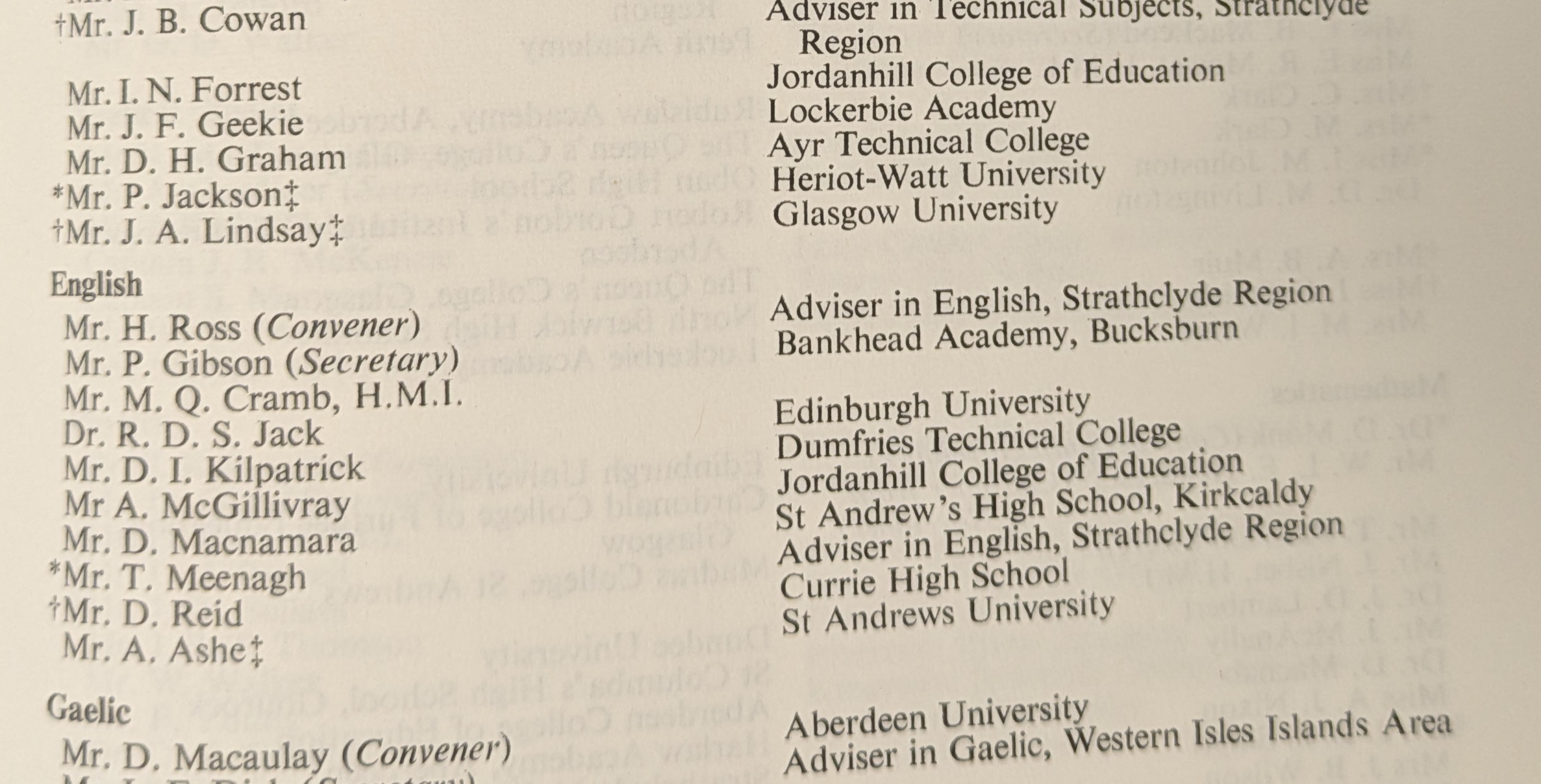
Two weeks later I have a list of the ‘English Panel.’ Excellent… except they only list a first initial and second-name. Random names like ‘ME Mills’, and ‘D Macnamara.’ I compile these into a spreadsheet and then start trying to work out how I am going to contact them. My solution is to use ‘192.com’, which contains the open electoral roll (and various other databases). I then cross-reference it with the birth, marriage, and death records, and public obituaries.
This approach allows me to narrow my list down to 8 people. One of the strengths of the open electoral roll is that it includes the addresses of those listed (often to their annoyance). By cross-referencing these with estate agent house listings I can determine which are likely to still be relevant. Unfortunately, due to only having the first initials of the English Panel members, I have to send multiple letters. I send around 23.
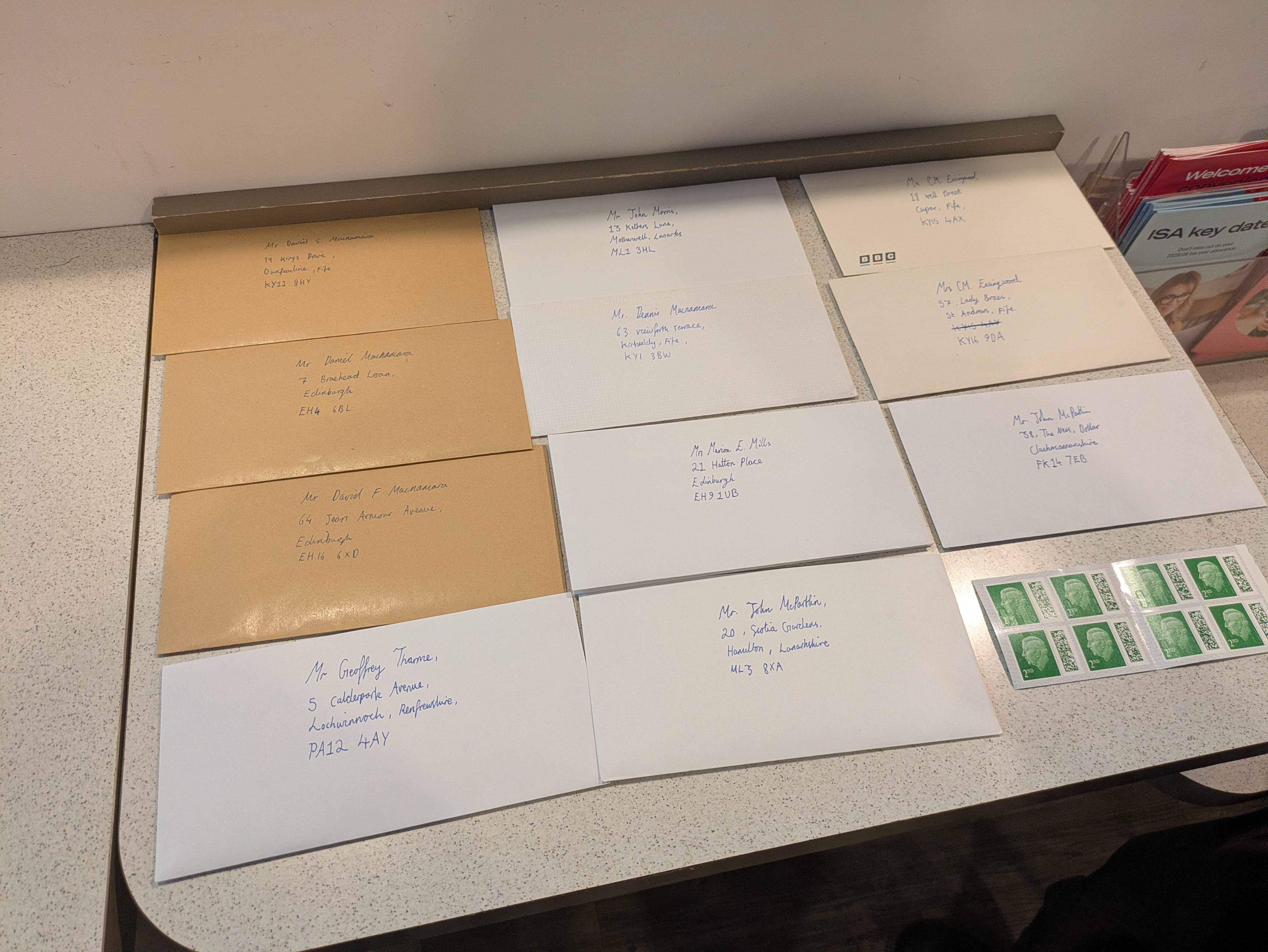
I wait. Three weeks later I receive a text from “Dennis Macnamara.” I phone him the same day. He has a broad Scots accent and speaks with perfect grammar. I felt somewhat interrogated as he scrutinised how well-formed my sentences were. “Aye, I know who wrote those exams.” Great… “He was a powerful man, full of sound of fury. If he didnea agree with you, he’d sweep you aff your feet into the dustbin!... Aye, but he was a fair man too and all, a fair man…” And his name…
“I cannae remember!”
Back to the drawing board. Over the course of the next two weeks I receive 3 more letters. The next is from ‘Marion E. Mills’, my ‘ME Mills.’ She too knew of this mysterious man. He was a ‘force in the land’, a ‘hard man’, the great power who controlled the all-important Higher exam as well. ‘We were all afraid him.’ I also glean useful biographical details: he was a Roman Catholic, a man of fiery temper, and the head of a massive English department in Glasgow. And his name…?
“Jack…”
“And…?”
“I cannae remember!”
Finding this man was proving to be much harder than I anticipated. The next person I found was Claire Easingwood, and via her, a colleague called Ann Bridges. Ann remembered Jack… although not his second name. He was a heavy drinker – ‘marking only stopped when his pint ran out!’ He smoked like a chimney and drank like a maniac. He was famous for holding the attention of thousands of markers as he began the marking process. “Aye, he knew how to run a meeting!”
Three months pass, and I get another email from Marion E. Mills. She has contacted her boss, who remembered Jack’s second name: O’Neil. And so the hunt for Jack O’Neil progresses another step. Unfortunately, this is where I stop. I have not been able to find Jack O’Neil’s address (although I have sent several letters to ‘Jack O’Neil’s and contacted Glaswegian Roman Catholic churches), nor his obituary. Nonetheless, he is almost certainly dead. No younger than 40 in 1970, he will be 96 today.
Jack, according to all I have spoken to, was a vast, thundering power in Scottish Literature examinations. He derived many of his questions, alongside a similarly unique man Jimmy Inglis, from the famously intellectual Listener Magazine. It is unsurprising the English CSYS would be produced by men like this. The Scottish examination system in 1940s to the 1980s was staffed by strong men who loved literature: Dr. William Gatherer, John McPartlin, Jimmy Inglis, Jack O’Neil, and many more. The English Panel members were extraordinarily helpful and kind, many of whom invited me into their homes. Our examinations today are poor showings, but perhaps this is not surprising. The examiners in the late 1980s gave up on creative, idiosyncratic questions. They turned to routine, predictability, and standardisation, in order to better ‘serve the customer’ (students), and save time for themselves. But that is a story for another time.