
"Ronnie?" Nope! "Larry?" Nope! "Steve?" Nope! "Harry?" Sure! You got it! The train explodes in celebration. Cheap beer and cider splatter the ceiling. Hugs and air punches. The Footballers believe they have guessed my name, but they have been deceived. My true name is Alexander. Welcome to the 'Quiet Coach' of the GWR Paddington-Oxford line. Oxford United has just gone up a division and morale is high. A pair of old ladies whisper behind me "they played jolly well, they deserve a bit of fun."
The Fans chatter about the game, re-living highlights and grouching about poor referee decisions (albeit without the real malice of losers). I zone out. When I tune back in they have moved on to a different conversation:
Fan 1: ... do you think you'd die for your country?
Fan 2: whaddyou mean?
Fan 1: like, would you fight for England?
Fan 2: I guess... I don't know, yes, yeah I'd fight
Others joined in saying they'd 'do in' anyone who threatened England, others asked whether they'd be going to fight abroad, lots of joking about driving tanks. Some piped up immediately and proudly, others were more reticent. One man, during a pause, in a low voice asked:
Fan 3: ... but what even is England? I don't know anymore...
Would you die for your country? I have started asking my friends this question. Most assume I mean in another pointless foreign war. Not so: I mean "If it would make a difference, would you risk your life to defend your country?" Most are bemused and shrug "No idea, perhaps but it depends." Many would simply run away. "I'd probably just leave." These are your typical middle-class professionals: lawyers, doctors, teachers. Some are creative types like animators, others part of a slightly more elite milieu - Oxbridge academics, third culture kids doing abstract knowledge-work, city lawyers. If war came to British shores they would run away; and if that country was invaded? The would continue to flee.
Historically, it was only the upper-class who could afford to endlessly run away. During WWII the question was explicitly class-coded. The public and political elite naively assumed everyone would fight to defend the realm. Aristocratic Brits who evacuated their children abroad, or even ran away in toto, were derided as 'Funkers' ditching Blightey on the 'Funk Express.' The poet W.H. Auden, for instance, was shamed for 'deserting' to America, alongside other runaways like Isherwood and Aldous Huxley. Last year I visited a funk pleasure dome in Portugal, Monserrate Palace, home of the art collector Sir Herbert Cook. Monserrate is a beautiful romantic folly where spies dined with British aristos and children enjoyed 'Indian summers' in between flights to boarding school.
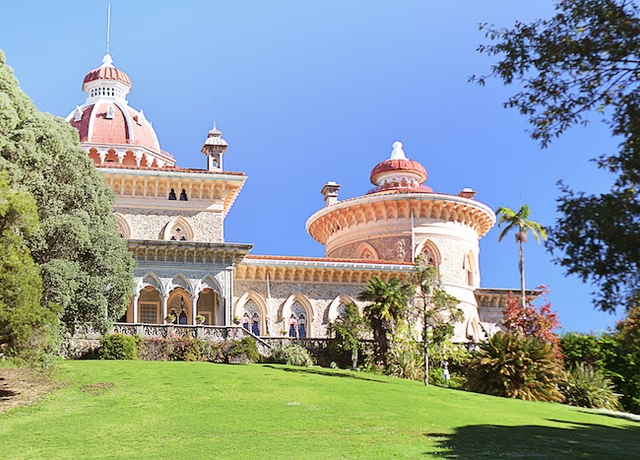
There is something parasitic about living like this. It reminds me of something I learned about in high school called 'The paradox of cosmopolitanism.' The cosmopolitan 'global citizen' likes travelling the world experiencing diverse local cultures. Mexican tacos. Japanese Noh. Scottish ceilidhs. They cannot get enough of the Global Banquet. Yet if everyone was a cosmopolitan, no rich local culture would be produced for the cosmopolitans to sample. Dying for your country is the purest expression of this paradox. "I recognise that my liberal cosmopolitan lifestyle is threatened by the foe, but someone else can defend it for me." It is a pathetic way to live. On the surface you don't notice the contradiction - it doesn't come up much does it? If pressed on the point, well, yes I suppose someone else can get their hands dirty, someone else can die:

It is easy to dodge the question. Perhaps the country is corrupt? Perhaps the social contract has broken down, where the rich and poor, city and country, no longer speak the same language? Perhaps it's 'not the same as it was.' For whatever reason, the mandate of Albion has been revoked. So you run away. And if your new home becomes dysfunctional? You can run away again. Why bother sticking around to improve anything? It's no different from the hollowing out of small towns, and then cities, and now entire countries.
But the people who always run? I don't trust them. Not a bit. I get the whiff of a certain odor: We are not in this together. They are just visiting. Visitors can be many things. They can be fun to hang out with. They can be kind and generous people; they can share the same values. They can contribute in big and small ways to the tempo of daily life. But they won't stick around to build anything lasting. They won't defend us. They're just passing through.
I'm left, after all these gloomy thoughts, with Football Fan #3's lament: "...but what even is England?" A distant memory comes to mind. My friend and I were touring local pubs in the mild Cantabrian summer. We are walking back in dusk, barley fields are on the left, river Cam on the right. For no reason in particular, we decide to stop by a small parish church. It is unlocked, cool, lit by stained glass. There is nothing special about it; like many local churches it is slowly ageing into desuetude. An unattended sign sells Victoria sponge for £2; I buy a slice. As we leave, my friend sighs and mutters something.
"Sometimes it feels like what I love most in England is just... vestigial."
What is there left to fight for? What even is England? A great confusion blankets the land. Only football fans seem to ask these questions seriously. Perhaps it is because they sense intuitively whom will be forced to defend the land when push comes to shove, and why it matters they have something to fight for. In contrast, my set are not merely willing to funk but salivating and desparate; those who, through tireless, good-natured work, seek to disintegrate the outdated notions of everyday football fans.
When priests are more in word than matter,
When brewers mar their malt with water,
When nobles are their tailors’ tutors,
No heretics burned but wenches’ suitors,
When every case in law is right,
No squire in debt, nor no poor knight;
When slanders do not live in tongues,
Nor cutpurses come not to throngs,
When usurers tell their gold i’ th’ field,
And bawds and whores do churches build,
Then shall the realm of Albion
Come to great confusion;
Then comes the time, who lives to see ’t,
That going shall be used with feet.
This prophecy Merlin shall make, for I live before
his time.
King Lear, A. 3, s. 2
And their work is succeeding. The picture of England is becoming confused in the minds of my travel companions. What it is that binds them to the elites, those words which might give them a vocabulary to criticise funking? The fans ask 'why do you hate our country?' and are met with a paternal smile: 'didn't you hear? There is no such thing as England.' I often wonder where we are drifting. At times, the country feels like a cell exposed to radiation. Its strands of DNA are breaking down, damaged, dissipating, there is no longer coherence to the organism. The dose is possibly fatal, and as we dissolve, other creatures look on with a mixture of pity and hunger.