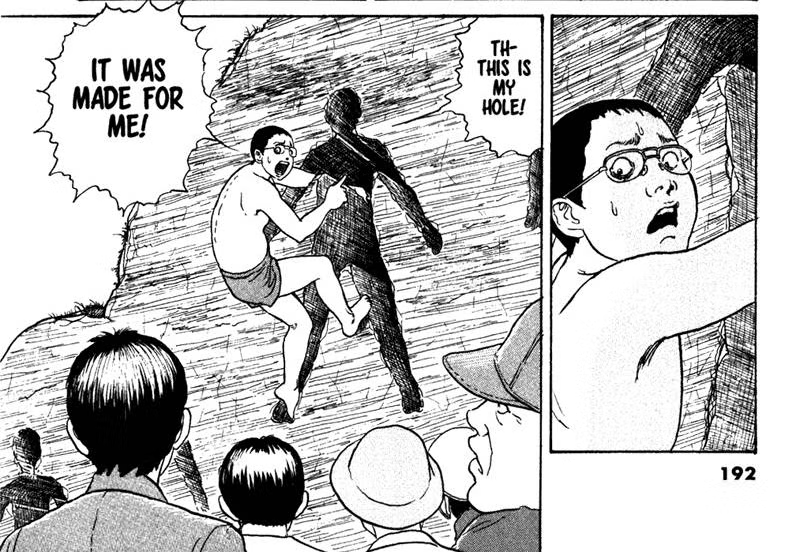
"People can become whatever they want to become."
"Of all the people in the world, they are those who most love their children and treat them best."
In the 2000s reality television show ‘Faking It’, an ordinary person must transform their
personality in one month. Oxford Chemistry Undergraduate to East End Bouncer, Cellist to DJ, Burger
Flipper to Elite Chef. They often succeed, and in one case the transformation was so radical he chose
his new identity over his old.
We love mutability. We love optionality. We love change. The story above is supposed to be
liberating, but I find its message sinister. I recoil from seeing how the essence of humanity is
celebrated as putty. What of those darker transformations we see in those around us? Those people whose
preferences have been permanently warped by trauma, or who have undergone enormous body modification?
The addicts, cranks, crazies, down the rabbit-hole, fully pilled, MAXXED, and ready for action.
Countryside children distorted by algorithms into arbitrary, perverse shapes.
What scares me about humankind is our adaptability. In the 30's, Beveridge reported the ‘five
evils’: want, disease, ignorance, squalor and idleness. What he did not realise is that the material
evils cannot be defeated. Give someone more food, at lower prices, from more countries, than ever in
human history, and they will want more. They will complain if they cannot buy exotic fruits at all
times of the year in all parts of the country. Provide someone with every possible cure, every means to
treat existing diseases, and you will find there are always ‘unacceptable results’, even from the
smallest of ailments. Give them endless convenience, and they will complain a short queue is too long.
The hedonic treadmill, the karmic wheel, never stops revolving. There is no ‘finish-line’, no great
‘completion’ of ‘that’s enough.’ Only growth, endless growth.
The best thing about dogs is that we can make them into whatever we want. We design
some to kill and hurt without control, others to be utterly, stupidly dependent on us no matter what we do.
If you like, a dog can be tailored to the point they suffocate on their own faces. We like to imagine humans
are not like this, but we are. Children adapt horrifically quickly to abusive relationships; to polluted environments, to
missing communities. The ill and depressed adapt to their condition and take it as their place in life. Nations and peoples
adapt to oppression and come to internalise it. To have their dreams re-dreamt. Now, with genetic
engineering, and superpersuasion nothing is off limits! The kind can be made cruel, the cruel kind. The
strongest, purest emotions can disappear overnight. People can become whatever they are made to become.
The horror of accelerationism is not that Things Fall Apart, but that we break that final link in
the anchor to humanity. We become Other, in the truest, bleakest sense of the word. To those who
suggest all people can become good, the riposte isn’t that people can become bad too – it’s that they
can become anything, that they can change too easily. The pathetic dot, hemmed in, ground down from
every angle, given shape by forces holding the circle in place the dot itself didn’t want or choose.
The reverse, that human beings have an innate, universal essence, is comforting. It suggests that if
you push human beings far enough they don’t adapt, they break. That there is a rigid core of
‘humanness’ resisting what is done to it. That when I look up at the stars and dream, I dream the same
way as those in the past; that those very different from us, across oceans and millennia, still loved
their children in the same way. From these meditations I now understand why, in the direst of conditions, it is a curse for
humans to adapt and live, and a blessing for them to lose their humanity and die.
Dr. Alexander Thompson