The Controlled Demolition of the Scottish Canon
This is the brief and rather sad story of how Scotland demolished its literary canon in the early 2000s. It is also a personal account: I went through the Scottish system after the ‘controlled demolition’, and experienced many of these changes first-hand. It was only a decade later that I realised what had been done to my curriculum.
0.The Great Tradition
Historically, Scotland had one of the strongest education systems in the world. Between the 1940s to the 1980s, the top 5% of Scottish students were at parity with the best students globally (although the average pupil of Scotland was only at the level of an average nation).1.‘What has happened to the democratic intellect? The neglect of knowledge in Scottish educational policy’, Professor Lindsay Paterson, lecture given at the Royal Philosophical Society of Glasgow, 5th March 2025. For the video, find here. English teachers in Scotland were part of this system and referred to their inheritance as The Great Tradition.
“It is a great thing to be a Scot, and it is a great thing to be taught in a Scottish school […] You have inherited a great tradition, and you must prove yourselves worthy of it. You who are to be the citizens of the future, must try to understand the privileges you enjoy as the members of a great democracy. That, children of Scotland, is the part you have to play as world citizens. If you play it well you may rest assured the fame of Scotland shall continue to be great amongst the nations.”
— The Children’s Story, 1938 [here]
It was an extremely rigorous and thorough-going education. In 1905, the report from the Western Division presented what the inspector described as the experience of a typical female pupil aged 13 in a good school (SED, 1905: 388):
“[S]he had read literature by Shakespeare, Scott, Tennyson, Longfellow and Dickens, had studied the history of ‘India and of the Colonies’, taken a course in citizenship, learnt the basics of hygiene, and also had classes in music and physical exercise.”2.Paterson, L. (2021). ‘The relationship of the 1918 and 1872 Education (Scotland) Acts’, Scottish Educational Review, 53(2), 88–103. brill.com/view/journals/ser/53/2/article-p88_7.xml
And another school inspectorate report, this time for a working class girl, recorded a reading schedule more advanced than most 16 and 17 year-olds in a modern secondary:
“The school is typical, working class. In these 7 months this 13 year old working class girl, and the teacher revised, the Merchant of Venice, Christmas Carol, Neville Abbot, Enoch Arden, Evangeline.”3.Paterson, L. (2021). ‘The relationship of the 1918 and 1872 Education (Scotland) Acts’, Scottish Educational Review, 53(2), 88–103. brill.com/view/journals/ser/53/2/article-p88_7.xml
Sir Walter Scott is no longer taught in Scottish schools at any level, given The Waverley Novels are uniformly considered too difficult and inaccessible for children. Instead, in my final years, I studied the following catalogue of books: Of Mice and Men, by John Steinbeck, Tess of the D’Urbervilles and The Mayor of Casterbridge by Thomas Hardy, The Crucible by Arthur Miller, The Cone Gatherers by Robin Jenkins, and Uncle Vanya and The Cherry Orchard by Anton Chekhov.
These are a fine mixture of novels and plays, if a little light on poetry, but they hardly constitute a coherent or sensible body of writing to study. My historical curriculum was similarly incoherent, covering (a) The Transatlantic Slave Trade; (b) German Unification; (c) Nazi Germany; (d) The Scottish Wars of Independence; and (e) The Russian Revolution (in that order). By the end of my ‘education’, I found myself in the same position as Nicholson Baker’s Mezzanine protagonist:
“Chance found me that day having worked for a living all morning, broken a shoelace, chatted with Tina, urinated successfully in a corporate setting, washed my face, eaten half of a bag of popcorn, bought a new set of shoelaces, eaten a hot dog and a cookie with some milk; and chance found me now sitting in the sun on a green bench, with a paperback on my lap. What, philosophically, was I supposed to do with that?”
— The Mezzanine
My diet of learning was the result of reforms carried out in the 2010s known as the ‘Curriculum for Excellence.’ According the curriculum specification for the curriculum, the learning objective for “developing an awareness of the relevance of texts in my life” is listed as:
“I regularly select and listen to or watch texts for enjoyment and interest, and I can express how well they meet my needs and expectations, and I can give reasons, with evidence, for my personal response.” (LIT 3-01a)4.Scottish Government / Education Scotland, Curriculum for Excellence: Literacy and English — Experiences and Outcomes. The outcome LIT 3-01a appears in the official All Experiences and Outcomes document, learn.sssc.uk.com/observing/downloads/all-experiences-and-outcomes.pdf.
There is no sense of acquiring knowledge, or developing taste, or becoming encultured in a literary tradition. It is entirely pupil-focused, even framed in the first-person, and success is defined purely subjectively. What happened to the Great Tradition?
1.The Curriculum for Excellence (2007–Present)
To keep this as robust and honest as possible, I am going to work backwards from the original source of the rot. The Curriculum for Excellence was a curricular reform designed in the early 2000s under influence from an OECD report in 2007.5.OECD (2007). Reviews of National Policies for Education: Quality and Equity of Schooling in Scotland. Paris: OECD Publishing. Available at oecd.org. This report claimed found Scotland had unacceptable levels of educational inequality driven primarily by an over-emphasis on knowledge and ‘rote-learning’ in the place of a more holistic ‘skills-based’ approach. Such a focus was said to disadvantage the working class child.
In the words of the report, the Scottish system’s problem was that it was “mainly academic”, and the excessive “academic culture” at schools. A “strong emphasis on examinations in subjects of an academic or general kind favours” what the report calls “middle class aspirations.” These “findings” are unsurprising given the main author of the report, Richard Teese, is a leading interpreter of Pierre Bourdieu.6.Raffe, D. (2008). ‘As others see us: A commentary on the OECD review of the quality and equity of schooling in Scotland’, Scottish Educational Review, 40(1), 22–36.
For those unfamiliar with Bourdieu, he is most famous for his ‘habitus theory.’ One’s habitus is the full set of dispositions picked up throughout life; it is so deep that it feels ‘natural.’ Your habitus is shaped by the various ‘fields’ in society, such as academia, medicine, journalism, with their own sorts of capital. In the school, for example, one might acquire ‘cultural capital’ which one can take into politics, university, journalism, or social life. The influence of habitus is so pervasive that working class boys do not even realise they are being oppressed when they choose not to study Shakespeare or pursue an academic career.
There is no such thing as ‘good art’, or ‘classic literature’, merely the art and literature of the dominant class which is then believed, because of how pervasive habitus is, to be ‘objectively good.’ A simple way to show how this applies to the curriculum is to compare Bourdieu with Matthew Arnold. A follow of Arnold might ask whether we are teaching “the best that has been thought and said” to every member of the community. The goal of the progressive Arnoldian is to widen the access to this tradition. Simple examples of 'Arnoldian success' can be found in Jonathan Rose's Intellectual Lives of the British Working Classes. 7.Rose, J. (2001). The Intellectual Life of the British Working Classes. New Haven and London: Yale University Press. . Rose found that Welsh coal mining communities and Northern factory hands preferred Shakespeare, Homer, and Austen because they believed it was the best that could be read. George Orwell reported similar reading habits in poor children during the 1940s:
“Dickens (especially David Copperfield), Defoe, and Stevenson are steady favourites, and Wells, Kipling, Blackmore, Tom Hughes, Conan Doyle, and G.K. Chesterton all appear on the lists. Poetry is less well-represented, the favourite poems usually being patriotic battle-pieces, but Shakespeare seems to be fairly extensively read. Consider that the children under examination are aged 12–15 and belong to the poorest classes in the community, these results are extremely encouraging.”8.Orwell, G. (1940). ‘Boys’ Weeklies’, first published in Horizon, March 1940; collected in Inside the Whale and Other Essays (Gollancz, 1940) and in Penguin editions of Orwell’s journalism, including The Penguin Essays of George Orwell (Harmondsworth: Penguin, 1984).
In contrast, Bourdieu would ask: “whose culture is being transmitted, and whose is being excluded or marked as deficient?” When children voluntarily read Austen, Dickens, or Shakespeare, it is important to question their motives and whether they are unintentionally reproducing the cultural capital of dominant groups. Any sense this art is ‘high’, or ‘better’, or ‘more beautiful’ could be an internalised habitus, an instance of 'symbolic violence', which will serve to disadvantage them in the long-run.
You can see, fairly clearly, how this interpretation would inform the OECD report. Scotland has inequality in its education system; it also has a famously academic and rigorous curriculum. Naturally, it is this powerful and pervasive culture which is producing the inequality. If we remove the hierarchy of values, de-emphasise ‘middle-class’ knowledge, then working class children will start performing better. One does not learn knowledge in school, but ways to engage personally with books and history in ways that suit each individual child.
The Curriculum for Excellence has not achieved its ends. In fact, Scotland's international test scores have fallen across the board, with the poorest children declining the most. The Arnoldian would have a clear answer. Bourdieu is correct that institutions set up hierarchies of values, but these reflect genuine differences in aesthetic and intellectual quality. Flattening the hierarchy does not make literature more accessible but rather destroys what was supposed to be shared in the first place.
2.Destroying a Century-Old Tradition (1997–2007)
It is not as if the 2007 OECD report descended from heaven and suddenly brainwashed the Scottish populace. Rather, the education department readily adopted its recommendations in the hopes it would improve the performance numbers of the Scottish education system. From what I can tell, the water had been changing for several decades. The most important transitional event was the fusion of the Scottish Exam Board (SEB) and the Scottish Vocational Education Council (SCOTVEC) in 1997.
The Scottish Exam Board (previously referred to as the Scottish Certificate of Education Examination Board) was the guardian of an ancient order. The Scottish Certificate of Education was first rolled out in 1888 and had been running continuously, and successfully, for over a century. The SEB was a small, tightly-run organisation constituting around 64 permanent employees working out of Dalkeith. From my interviews with them, I learned these employees tended to be the top academic talent of the United Kingdom, having attended Oxbridge or one of the four Ancient Universities of Scotland.
Every exam cycle, the SEB would call together hundreds of teachers, university professors, and school inspectors to create the examinations for the following year. I have met around 20 of the men and women from the 1970s, 1980s, and 1990s who worked on the English exams. The creation of the exam was regarded as ‘a fierce academic debate’ in which the teachers and academics would go with ‘hammer and tongs’ at for hours at a time. Those in charge of the examinations, such as Dr. William Gatherer, Jimmy Ingles, Jack O’Neil, and Campbell Cassidy, were highly erudite, academic individuals. Unsurprisingly, the examinations they produced were at an extremely high standard.
Nonetheless, in the 1990s there were concerns over the division of the academic and vocational qualifications. The eventual conclusion of the Scottish Education Department was that the two should be combined and thus the SEB prepared for fusion with SCOTVEC. The latter organisation was rather different from the SEB. It had far more employees and cost far more money; many of its members were from the business world and had little experience teaching. Ron Tuck, its chairman, had worked at a brewery and owned a football club. Most of those at the SEB regarded SCOTVEC as a ‘bunch of suits’, whilst conversely, SCOTVEC regarded SEB as too precious and elitist about their examinations.
The fusion of these two institutions was not an easy one. The vast majority of SEB members seem to have been left behind and, in general, the SCOTVEC culture dominated the new QUANGO, the “Scottish Qualifications Authority” (SQA). Shortly after this fusion, one of the worst exam scandals in history occurred due to a technical error. The SQA issued hundreds of incorrect results to candidates (most famously failing a native Russian speaker in his Russian exam), and many blank qualifications.9.Paterson, L. (2000). Crisis in the Classroom: The Exam Debacle and the Way Ahead for Scottish Education. Edinburgh: Mainstream. Thus, in one year, the SQA manage to successfully destroy the reputation the SEB had been guarding for a century. One senior SQA member, whom I promised I would not name, said the following when asked why the SEB was so well-respected:
“The SEB were the ‘custodians of the Holy Grail, the Higher’; the system had worked for years and was hugely respected by the Scottish public. They had made no changes to expose them to criticism and were protected from media flak because they were ‘steeped in tradition’ and ‘ran smoothly, with no mistakes.”
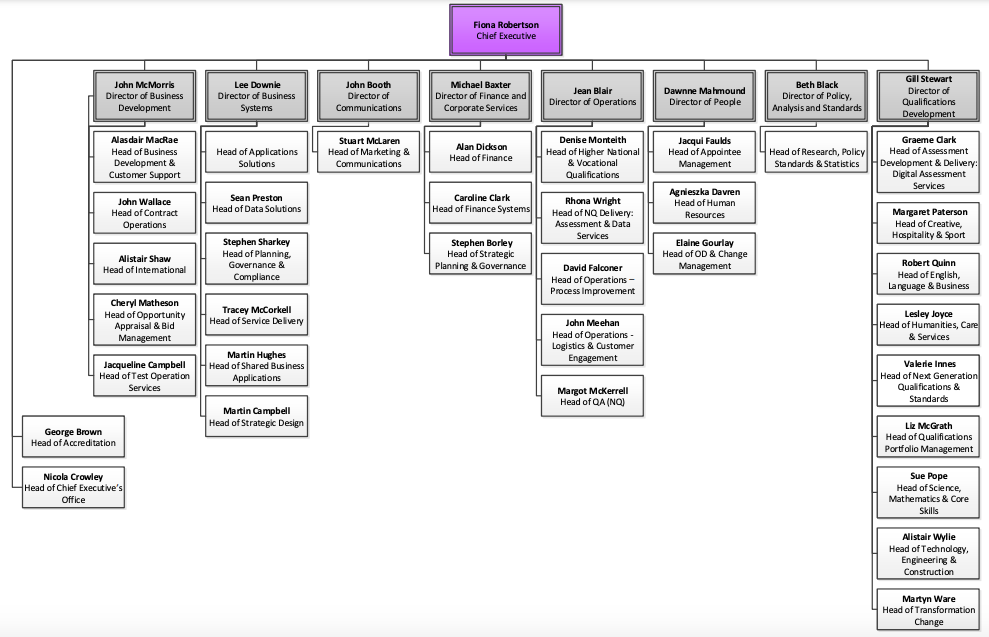
The SQA, along with the inspectorate, was the main force pushing forward with the Curriculum for Excellence Reform. They also, incidentally, wrecked most of the spirit of the old examinations by heavily standardising them. One of the chief examiners behind this decision straightforwardly said it was driven by reducing labour for examiners (because it made setting the questions easier), and teachers, who complained having unpredictable, open-ended questions made teaching classes harder. Unlike past examiners, this man had no experience teaching in a school and little love of literature. He was just trying to make his organisation run efficiently. The old examiners still look back very fondly on the 1970s and 1980s, regarding the SEB as a tightly run, close-knit organisation, but have little positive to say of the ‘90s. To get an idea of the organisation's 'ethos', here is the organisational chart from 2021:
3.Changing of the Seasons (1960–1997)
What happened to the SEB and why was it unable to fight the merger with SCOTVEC? To answer that question, we must go back several more decades. Curriculum reform resembles other massive public infrastructure changes. If you can lock-in your preferred curriculum when the pendulum is dead centre it can take a long time before the swing comes back for a second attempt. In England, for example, Dominic Cummings and Nick Gibb (with assistance from Michael Gove) managed to put in place a knowledge-rich curriculum. The New Labour government has proven unwilling to upset this change and, if it continues in place, it will likely remain for another decade at least.
The curriculum reform in the late ‘90s coincided with the retirement of the generation coming of age in the 1950s and 1960s. Like many British institutions, that generation was not replaced with ideological allies. Rather, it seems that the Silent Generation reformers of the ‘60s and ‘70s failed to reproduce their own movement, and were instead replaced by more Thatcherite, commercially-minded Boomers in the late ‘80s and ‘90s. These replacements proceeded to destroy, or allow fall into ruin, everything their Silent predecessors had fought to reform.
Explaining why this happened would require a detailed prosopography of the educational officials of the ‘90s, as well as a careful study of those who were excluded. I have not carried out this study, but what I can tell at the very least is that many of the idealistic, progressive institutions simply fell into desuetude in the late ‘90s. The long-running Teaching English magazine ran out of money; the teaching groups established in the ‘60s ceased due to a lack of interest; and the conferences set up to develop new teaching methods were unable to agree on teaching aims, teaching methods, or even, sometimes, a definition of ‘English’ itself.11.See the University of Stirling thesis on the history of English teaching in Scotland, available at dspace.stir.ac.uk/handle/1893/29486.
More broadly, by the ‘90s, neither the Left nor the Right supported a traditional curriculum. The Right, in the form of the Conservative party, had been well and truly taken over by Thatcherism, which preferred performance-metrics, standardisation, privatisation, and commercialism, to the illegible and dusty excellence of old cultural institutions. SCOTVEC is best seen in this light: not only was it a quasi-autonomous non-governmental organisation (running in a pseudo-business manner with a ‘chairman’ and ‘board’), but it was staffed by men of business.
The Left, on the other hand, abandoned the Great Tradition in the 1960s. Dr. William Gatherer is probably the most important figure here. He pushed heavily for the removal of formal grammar and an emphasis on more child-centred pedagogy. Teachers were not to force children to read things they did not want to read; they were not to didactically lecture them about stuffy facts, boring knowledge, or finnicky technical skills like verse: what mattered was honest, sincere self-expression. This movement, known as “New English” in England, was influential across the United Kingdom and succeeded in removing most of the internal structure of the English curriculum.
Until the mid-60s, an English teacher would teach a mixture of composition; formal grammar; etymology; literary history; and literary analysis, intended to go alongside the pupil’s other classes in Classics, History, Geography, and Mathematics. By the end of the ‘70s, most of this material had been taken out, with the exception of literary analysis. English therefore became a far more hermetically-sealed subject; it also became a far more subjective one. The main learning objective of New English was to transform consciousness, open one’s mind, and make contact with the cosmos. Strictures, rules, stuffy formalism, conventions, deferring to authority were all treated as out-dated relics of the old system.
Regardless of whether one prefers this type of English lesson, it is less effective at reproducing itself culturally than the Great Tradition (which lasted around 75 years). The examiner reports from the ‘60s, ‘70s, and ‘80s are filled with dismayed comments that the children continued to copy ‘defective forms’, failed to show originality; and in general produced composition of terrible quality. The children, with a few exceptions every year, were refusing to be transformed. Reading between the lines of Dr. Gatherer’s writing, one gets the strong sense that he did have very strong standards of literary quality but was unwilling to enforce them.
In an academic article,12.Gatherer, W.A. (1969). ‘English’, in Nisbet, J. and Kirk, G. (eds), Scottish Education Looks Ahead. Edinburgh: W. & R. Chambers. for instance, Gatherer spoke of Standard English being the natural choice for academic and professional discourse. In the English Bulletin magazines, further, Gatherer and his followers emphasised that although the teacher should not prescribe particular books, they should ‘gently guide’ pupils to truly worthy reading. The examinations his movement produced were extremely erudite given they were designed for 17 year olds, referencing figures like Freud, Julien Huxley, and Whitehead casually. If one reads carefully between the guidelines for answers, you get a clear sense that examiners expected fairly technical literary skills, from composing letters in the style of 18th century aristocrats to composing poetry in heroic verse.
The tragedy of the New English movement is that it expected the post-war generation of students would naturally love the same literature the Silents had been taught in The Great Tradition. I have previously compared this to King Lear: it is not enough that children love Shakespeare, Dickens, and Austen after being taught it rigorously in school, they must come to love it organically without teacher interference or even extensive scaffolding in class. They must spontaneously and freely develop the fierce loyalty their teachers demonstrated in class. That this does not seem to have occurred, or that Gatherer's students might prove uninterested in continuing their mission, is the tragedy of his generation.
Without wishing to digress too far, my father has suggested this same process occurred in the BBC during his time, and my supervisor has described a similar process the University system. My girlfriend and I have talked of this and both noticed how fantastically disinterested our highly progressive, ultra-liberal parents were in passing down generational knowledge. No musical instruments, few languages, relatively little in terms of formal knowledge in mathematics or literature. That is not to say we had poor childhoods – they were filled with freedom, nature, and self-directed fun – merely that little from our grandparents made it down to us deliberately. Something seemed to have changed in that generation.
4.The Poison in the Well (1880–1960)
I consider Gatherer and his followers the victims of a dysfunctional ideology. They believed the "New English" would serve their interests, that it would enrich the hearts and minds of their pupils, and continue the Great Tradition in a more humane form. Instead, it seems to have corroded the movement leaving scraps of loose flesh unable to cohere in the face of new political realities.
Where did this ideology come from, and what were its main components? Here is where this article will become more speculative. Tracing the Thatcherite reformers is trivial, because it is exactly, almost word for word, what Bentham recommended in the 18th century. The liberal position is more complicated and harder to explain. My working theory is that it represents a sort of pseudo-religion, rather close to Theosophy, which replaces the soul with ‘capacity to enjoy romantic beauty’, and distrusts formal structures.
The most important romantic movement in English teaching are the Poetic Humanists. They descend from the influential, although now widely forgotten, Victorian poet Matthew Arnold. Arnold proposed that in the absence of God, it would be necessary to use the arts – in particular the classics – to replace his role in society. Arnold himself was an Anglican but his theories allowed English to be patterned on to a number of Christian denominations. The Poetic humanists seem to be the pietist-romantic interpretation of Arnold’s theory. They believe literature is ultimately something you experience internally and subjectively. It transforms the mind and raises one’s consciousness; what matters is not stuffy form, but honesty, conviction, and good conscience.
You can trace various romantics to this school: Pater, Wordsworth, Blake, and, interestingly, F.R. Leavis. Although Leavis was committed to a rather rigid canon, he also spoke of the expressive, quasi-mystical qualities of art. At the International Dartmouth Seminar on English teaching in 1966, the English cohort were completely obsessed. According to a pragmatic, post-Sputnik American peeved by the Brits’ condescending, woolly, spiritualism, suggested “[T]heir God was D.H. Lawrence and their Prophet F.R. Leavis.”16.Muller, H.J. (1967). The Uses of English: Guidelines for the Teaching of English from the Anglo-American Conference at Dartmouth College. New York: Holt, Rinehart & Winston. This was the American report of the 1966 Dartmouth Seminar, paired with John Dixon’s British report Growth through English. Their credo could be summarised succinctly as so:
[Composition]: Give the pupils opportunities to be imaginative, creative, to express and discover themselves, their honest, deep-down, genuine selves.
[Literature]: But shouldn’t the great literary heritage be preserved and taught them for their and the culture’s edification? Rubbish! Let them read what interests them, what they want to read, what is relevant to their various interests.
[Pedagogy]: Don’t teach them; provide them an environment in which they can learn organically. The curriculum is their sequence of experience individually.
In the 1960s, David Holbrook was one of the most influential members up in Scotland. Interviews with contemporary teachers cite reading his English for the Rejected as a life-changing work. In brief, his theory is much the same as that of the Dartmouth cohort: English is a transformative subject which redeems and ennobles humanity. In his words:
“A revolution of approach—in terms even of recognising children as equal in the sight of God—or, as I would put it, in terms of psychic need, or needs of the sensibility—could relieve much of the suffering which comes to be expressed in various forms of hostility to school and the adult world among the less able, or emotionally disturbed or unhappy young.” (12)17.Holbrook, D. (1964). English for the Rejected: Training Literacy in the Lower Streams of the Secondary School. Cambridge: Cambridge University Press. The preceding page reference refers to this edition.
It is probably an over-estimation to regard Holbrook as the source of these ideas in Scotland; from what I can tell, they appear to have simply been in the water. It was almost like a spontaneous religious revival, except Christianity was being replaced with an extremely ecumenical non-religion. Charles Taylor has called it ‘Expressive Individualism’,18.Taylor, C. (2007). A Secular Age. Cambridge, MA: Belknap Press of Harvard University Press. The treatment of expressive individualism and the ‘Age of Authenticity’ is concentrated in Chapter 13. and Galen Watts ‘Romantic Liberalism.’19.Watts, G. (2022). The Spiritual Turn: The Religion of the Heart and the Making of Romantic Liberal Modernity. Oxford: Oxford University Press. Tom Wolfe, more disparagingly called it ‘The Me Generation’,20.Wolfe, T. (1976). ‘The “Me” Decade and the Third Great Awakening’, New York magazine, 23 August 1976; reprinted in Mauve Gloves & Madmen, Clutter & Vine (New York: Farrar, Straus and Giroux, 1976). whilst Christopher Lasch regarded it as societal narcissism.21.Lasch, C. (1979). The Culture of Narcissism: American Life in an Age of Diminishing Expectations. New York: W.W. Norton. Disentangling the New English from other changes in the period – such as television, the pill, the sexual revolution, the growth of eastern mystical religions, Americanisation, rock and roll, drugs – is difficult, although they seem to at least possess some elective affinities.
Every religion needs a theology to provide an intellectual foundation. New English's intellectual bedrock could be found in two places. First, the progressive pedagogies of Pestalozzi, Froebel, and, above all, Jean Piaget (much of which descending from Rousseau). These pedagogists recommended child-centred learning in the place of teacher-directed lectures from the dais. In Scotland, these ideas first entered in the mid-1960s at the Primary school level before filtering up to the Secondary school. Instead of sitting in rows, listening to teacher explanations, and doing exercises, progressive pedagogy suggests pupils learn best when interacting dynamically with problems. The new Scottish classroom would be arranged in islands of desks and would use 'project-based' work. A 'project' would cut across disciplines and involve practical, immediately relevant problems, such as drafting a radio play. In theory, this would give students independence and the freedom to be creative, freeing them from the old academic strictures of the exercise book.
Second, the work of socio-linguists in the 1950s, 60s, and 70s. Linguists like Robert Hall Jr and Randolph Quirk argued the Grammar School grammar was artificial and false, either representing completely arbitrary class distinctions or a mistaken attempt to apply Ancient Greek grammar to English.13.Hall, R.A., Jr. (1950). Leave Your Language Alone! Ithaca, NY: Linguistica (reissued as Linguistics and Your Language, Doubleday Anchor, 1960). Quirk, R. (1962). The Use of English. London: Longman (enlarged edition, 1968). Further, using anthropological research, they argued for linguistic relativism. Summarised in the catchphrases percolating at the time: “all children can speak the language they bring from home correctly”; “all languages evolve over time and there is no such thing as linguistic progress”; "you cannot shape language"; “formal grammar is just a mistaken attempt to apply classics grammar to English”; and “all languages are equally fit for communicating the needs of their users.” Almost every teacher I spoke to agreed the linguistics work of the '60s demolished the old system.
If you read Quirk and Hall carefully, you will find they do believe some forms of English (such as the form they write in themselves) are better suited for academic discourse. Some grammatical technique - especially written - does need to be taught, can be improved progressively, and, when lacking, will limit a child's means of expression. Gatherer's emphasis on Standard English, the implicit ranking of 'more sophisticated forms', and the examiner report dismay over 'poor models' incorporates this assumption. Nonetheless, it was not a stable position, given it seemed to exclude the dimmer pupils for certain kinds of literary salvation.
A second set of socio-linguist texts entered Scotland in the '60s and '70s which served to dissolve the remaining structures. Halliday, a marxist linguist, and Basil Bernstein argued that language could be divided into different 'registers.'14.Halliday, M.A.K. (1978). Language as Social Semiotic: The Social Interpretation of Language and Meaning. London: Edward Arnold. Bernstein, B. (1971). Class, Codes and Control, Volume 1: Theoretical Studies Towards a Sociology of Language. London: Routledge & Kegan Paul. The language used in school reflected the register of middle-class families. Insisting that working-class children come to school with mastery of these registers would alienate them from their own natural speech. Halliday recommended a more balanced approach, where students spent less time on didactic, academic lessons, and more on fluid, oral, everyday speech.
These are the early intellectual seeds of the ‘Curriculum for Excellence.‘ What made the critical theories of Halliday and Bernstein (regarded as the 'enfant terrible' at Dartmouth Seminar) so compelling was that they confirmed what the New English movement claimed about salvation through poetry. Everyone in society could be brought together as one, provided, that is, we discard the academic, conventional, and formal. What could be better than new linguistic research which seemed to claim High and Low registers were socially constructed? That everyone, just as they were, could express beauty, insight, and truth with their home language. More widely, it seemed to flow with the times: it matched the move to comprehensive schooling; the widening of university access; and the broader challenges to the old class system.
The only problem is that, in the words of one interviewee, the subject was left without any structure. English contained very little formal content, nor, given the attitude of New English, did the teacher seem to have any academic expertise beyond their guru-like insight into the cosmos. The learning objectives were also proving almost impossible to define in a non-solipsistic manner, and impossible to defend without any sense of High or Low culture. Deep in the archives of the New English reformers, one finds their discussions of 'Americanisation', and 'costa brava dreams', of 'pop music displacing folk music', and the brilliance of the 'radio ballads.' But how could any of that be formalised in the curriculum when it was up to the child to find their path? One of my partner's education policy colleagues summarised it neatly: "I don't like ‘should‘ it's too... oppressive."
5.A brief conclusion
Professor Lindsay Paterson, whose work has inspired much of this article, put it quite succinctly in conversation. "Every country must negotiate with its cultural heritage." Some countries did so with a reasonable amount of equanimity: the Japanese, the Swiss, and the Norwegians kept national curricula with differentiation between the academic and non-academic tracks. Scotland faced a particularly difficult challenge because of how elite its top level was. It had to find a way to expand the traditional academic curriculum to mass education without losing rigour or quality.
Although Scotland seemed to be succeeding in the 1960s, 70s, and 80s, successfully extending the Highers to more and more pupils, everything collapsed in the early-2000s. The most controversial claim in this piece is that the demolition was the product of ideological changes from those earlier years which destroyed the foundations of the whole structure. You can only torch the canon once, and I fear the heat in the '60s and '70s was not the first touch of sun outside prison, but from the blaze of irreplaceable cultural traditions burning to ash.
A retired, post-Silent teacher gives a good example. In the '60s and '70s she 'did very well' bringing the radical English of England to the stuffy Scottish schools. 'They loved the rebellion!' But by the '80s and '90s, there was no traditional system to rebel against . Instead, she was being outflanked by Thatcherite reformers who agreed with her child-focused, individualistic, 'needs-based' philosophy. We agree! Don't you see? We are in favour of a 'consumer-focused' system, where children can 'pick-and-choose' modules like 'the Russian Revolution' or 'Advanced Woodwork' freely. Where, exactly, is the oppression here? If anything, your approach seems overly paternalistic. How does poetry help a working-class pupil become more employable?
In some ghostly sense the Great Tradition still lives on. I have scanned hundreds of examinations from the National Archive and have been collecting the old textbooks. Every year, the Archive destroys files to make more space for newer records, and so I rush to scan what may otherwise be lost forever. I hope in the future to start my own school and resurrect this Tradition. We have inherited a great tradition, and, although our parents failed, there is still time to prove ourselves worthy of it.